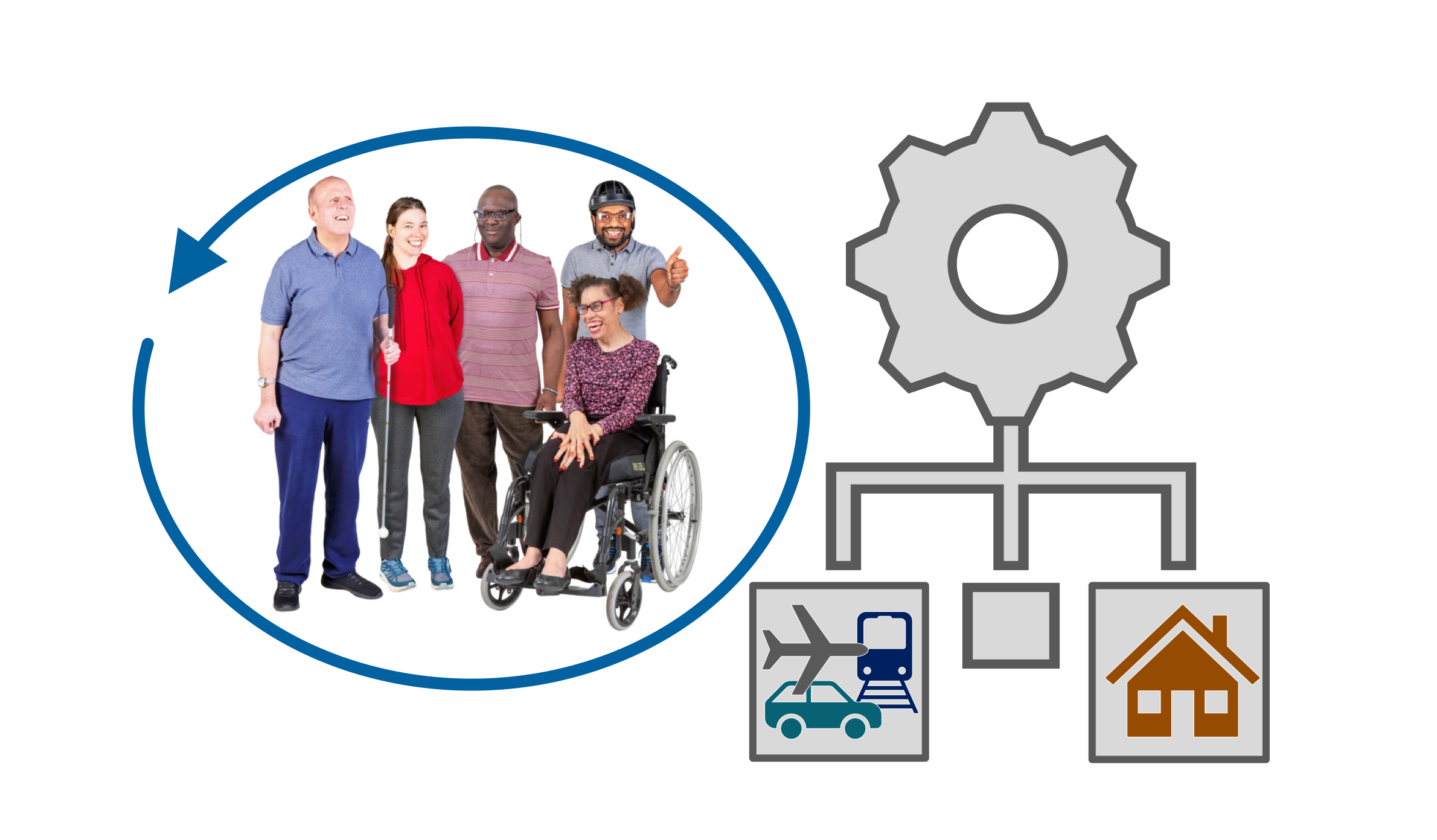
The Amman Center For Human Rights Studies (ACHRS) continues to monitor and engage with developments within international human rights mechanisms, particularly those aligned with our priorities. In January 2026, the Office of the United Nations High Commissioner for Human Rights published a thematic report, to the 61st session of Human Rights Council examining disability-inclusive infrastructure, with emphasis on transport and housing. The report expands on previous OHCHR analyses on support systems to encourage community inclusion of people with disabilities and was submitted in accordance with Human Rights Council resolution 55/8.
After COVID-19, concentrating on infrastructure:
The report notes how the COVID-19 pandemic both brought attention to and exacerbated pre-existing imbalances, placing its analysis within the framework of the global recovery following the outbreak. It builds on previous reports on support systems for inclusion, emphasizing that housing and transport are not merely services but integral parts of systems that enable people with disabilities to participate fully in society.
It also complements earlier OHCHR human rights work and support structures, adding a detailed look at the infrastructure’s role in everyday life and mobility.
Accessibility gaps in transportation:
A substantial section of the report focuses on transport infrastructure. The research uses data from throughout the world to show how people with disabilities encounter several obstacles that limit their mobility and social participation significantly more than others.
Studies cited in the report show that persons with disabilities may face up to 15 times greater restrictions on movement and participation due to inaccessible transport systems. Almost 50% of people with disabilities who participated in the poll said that public transportation was inaccessible, and many cited unfavorable staff attitudes and a dearth of services.
The report also underscores that barriers are often worse in rural areas, where transport services are limited and lengthier travel times to essential services. These accessibility issues range from lack of ramps and maneuvering space to inconsistent signage and inaccessible ticketing systems, which significantly restrict daily mobility for many people.
The report additionally notes that women with disabilities face disproportionate mobility challenges.
Housing being core element of community inclusion:
While transport gets the bulk of detailed examples, the report also discusses how housing accessibility is central to inclusion. Inaccessible housing stock, a shortage of reasonably priced accessible flats, and a lack of support services that enable them to live in the community rather than in institutions are some of the main obstacles that people with disabilities face while trying to live independently.
The analysis in A/HRC/61/32* broadens the scope of earlier thematic reports that examined human rights aspects of care and support for individuals with disabilities and support systems that facilitate community participation. These earlier documents laid foundational concepts around inclusion, accessibility, and rights based support systems, which the current report extends into specific sectors such as transport and housing.
Key Takeaways:
- Infrastructure as a rights issue: The report presents transport and housing access as crucial not simply as development or economic concerns, but as essential for the exercise of fundamental rights by persons with disabilities.
- Persistent barriers worldwide: Despite international human rights norms and growing awareness, significant barriers continue to limit mobility and participation for many persons with disabilities.
- Intersectional impacts: Data and examples in the report underscore that gender, geography, and socio-economic status intersect with disability to compound exclusion.
- Rural accessibility challenges: Lack of transport infrastructure in rural areas was highlighted as a widespread deterrent to accessing basic services such as health care, education, and employment.
- Continuity with past UN work: The report builds on prior UN analysis, situating transport and housing within broader efforts to understand how societies must adapt to enable full participation and community inclusion.
The report was presented at the 61st session of the Human Rights Council as part of a series of thematic reports intended to inform Member States, civil society actors, and international bodies about ongoing challenges and good practices. While the report itself does not contain binding resolutions, it contributes to the policy conversation and technical guidance on disability-inclusive infrastructure and is expected to inform future Council deliberations and national policy frameworks.
Read more about the 61st session: Disability-Inclusive Infrastructure session here.