Statement: International Workers’ Day 2026
Written by Tshepo Tlhacoane
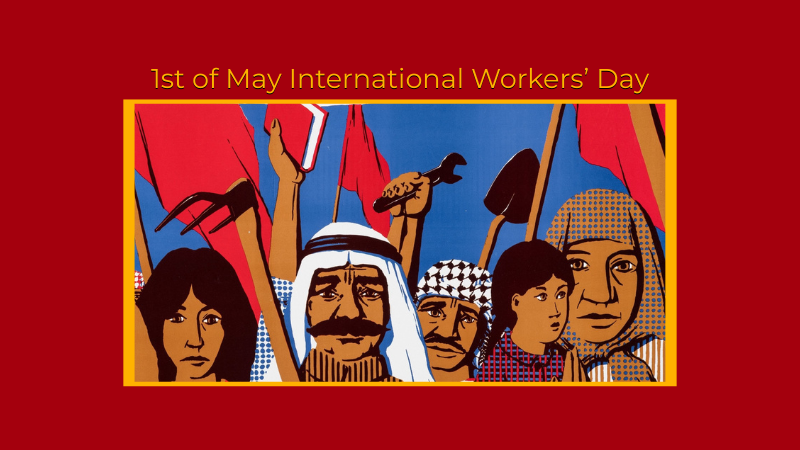
The Amman Center for Human Rights Studies (ACHRS) would like to use the occasion of International Workers’ Day to highlight some existing and emerging challenges that are being faced by workers globally and in the Arab Region.
International Workers’ Day is a day dedicated to the class and labour struggles that took place around the world in the 19th century, and is meant to appreciate the contribution of the working class to society and to remember all who sacrificed their lives to improve working conditions for all of us. From the eight-hour work day, to maternity leave and child labour laws, many protections afforded to employees today came as a result of demonstrations and protests carried out by members of the working class globally. Despite these advancements, traditional and emerging challenges pose threats to labour markets and workers.
Traditional Challenges
Gaining employment remains a challenge for many around the world, including the Arab Region. According to the International Labour Organization (ILO), the global unemployment rate for 2025 was 4.9%, while unemployment in the Arab Region was almost double that rate at 9.5%. Addressing unemployment globally and within the region is crucial in addressing social problems such as inequality and poverty.
Economic conditions and policies mean that those who find employment may not necessarily find their way out of poverty. Inflation, coupled with the stagnation of workers’ wages, means that one could remain in poverty despite being in the labour market. Globally, 1 in 5 workers still live in poverty despite being involved in the labour market. Additionally, nearly 300 million workers are in extreme poverty, earning less than $3 per day.
Another challenge to workers are low labour standards. In Rethinking the Fight Against Poverty and Inequalities: the Future of Work and Social Protection, a roundtable hosted by the ILO, labour experts pointed out that in addition to low wages, workers were being subjected to unsafe work environments, and that countries relied on the combination of low wages and low labour standards to attract foreign direct investment. ACHRS calls on all Member States of the International Labour Organization, particularly those in the Arab Region, to incentivise the promotion of the labour standards contained in the ILO Declaration on Fundamental Principles and Rights at Work and its Follow-up.
A final traditional challenge being faced by workers worthy of discussion is the exclusion of youth and women from the labour market. In 2023, of the 748 million people over 15 years old who were outside the labour market, 708 million were women, with 40 million being men. Care responsibilities were the main reason cited for women not participating in the labour market, with 59% of women in the Arab Region not working due to this reason, higher than the global average of 45%.
The global youth (15-24) unemployment rate stands at 13.4%. However, youth unemployment rates in the Arab Region are particularly concerning, with Algeria (29.4%), Iraq (32%), Jordan (38.9%), Libya (50.1%), Syria (33.1%), Tunisia (38.1%), and Yemen (32.6%) being significant outliers from the global average. Youth unemployment in the Arab Region as a whole stands at 25.5%.
Emerging challenges
The development and use of Artificial Intelligence (AI) presents both opportunities and challenges to those in the labour market. According to the International Monetary Fund, AI will affect almost 40% of jobs around the world. AI differs from automation and information technologies as these technologies were used for routine tasks. AI is different due to its ability to impact high skill jobs. While AI may compliment higher income workers, in most cases, it will likely worsen inequality, according to the IMF. Globally, we have already seen mass layoffs as a result of the adoption of AI, and this is set to continue as companies prioritize profits.
Although not as recent a challenge as AI, climate change also poses a challenge to the labour market. Climate change has the potential to adversely impact the livelihoods of workers in the agricultural, tourism, and industrial sectors, which are crucial in the region. According to a report by the Jordan River Foundation, at least 15% of households are impacted by climate change in Jordan through job loss or having to change jobs due to climate factors. There remains a low level of awareness of green opportunities, however, we are encouraged by the fact that of those surveyed, 97% were willing to adopt environmentally friendly practices. It is therefore crucial for governments to invest in sustainable agriculture, eco-tourism, and other green employment sectors in order to mitigate the harm suffered by climate-related impacts to the labour market.
Recommendations
Guided by the desire to see all people have good quality jobs, which pay workers a decent living wage, which can be performed in the best possible conditions, ACHRS calls on states in the Arab Region to:
- Incentivize the implementation and promotion of labour standards in accordance with the ILO Declaration on Fundamental Principles and Rights at Work and its Follow-up
- Consider establishing a national minimum wage for all citizens, where one does not exist
- Incentivize businesses to hire women and young people
- Enact and fund programmes that provide employment opportunities for women and young people, and
- Advance climate-resilient livelihoods and promote the green economy.