Israeli police raid Masjid Al-Aqsa, brutally attacking Palestinian worshippers
By Noussaiba Askar
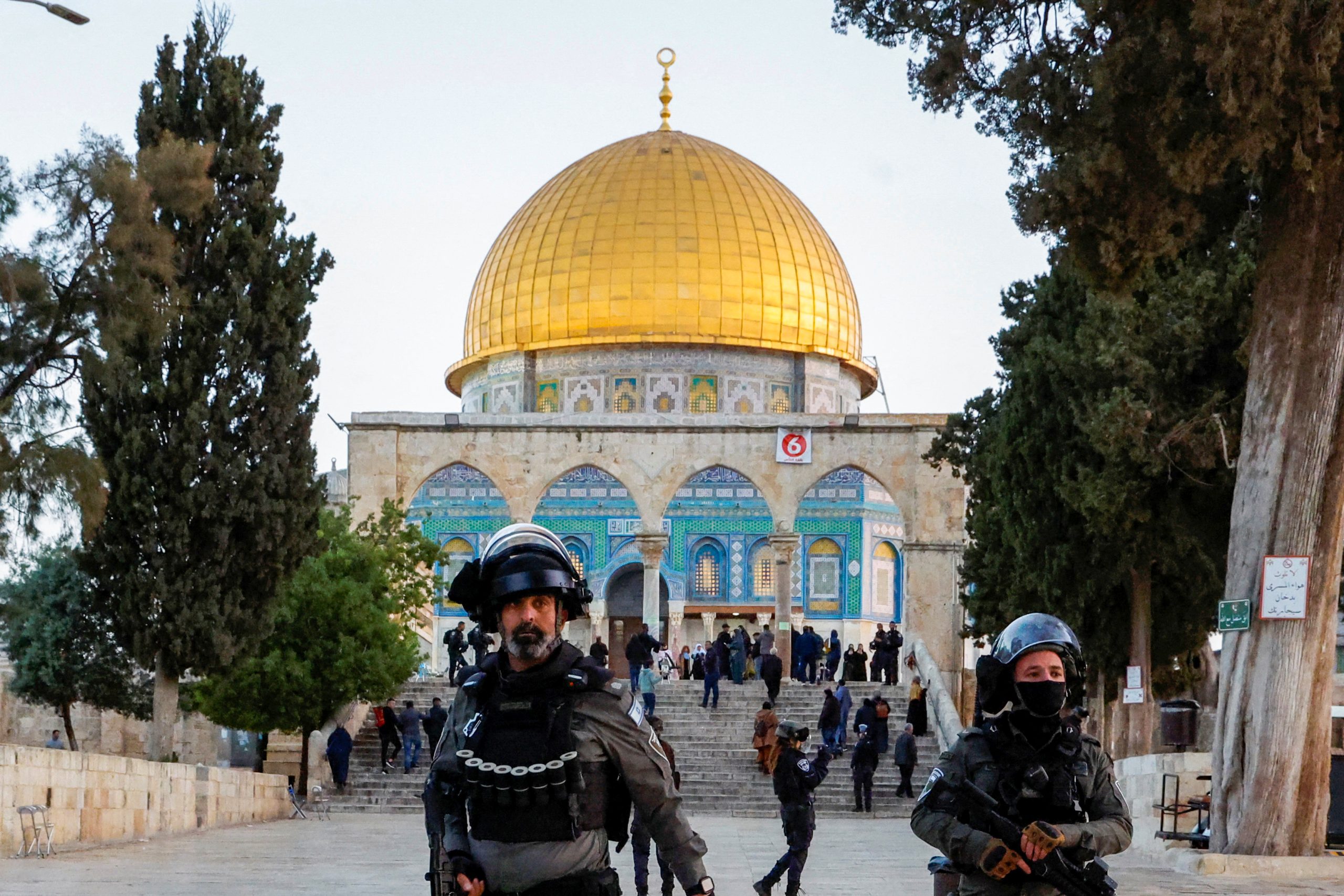
On the 14th night of the holy month of Ramadan, Israeli police stormed the Mosque of Al-Aqsa, the third holiest site in Islam, and attacked the Palestinians inside.
Attack on Islam’s third holiest site
The Al-Aqsa Mosque is one of the most important Muslim places of worship in the world. It is located on the Esplanade of the Mosques, the third holiest site in Islam, in occupied East Jerusalem.
On 29 March, following the nightly Tarawih prayer, dozens of Palestinian worshippers stayed to perform Itifak, a common practice during Ramadan of remaining inside mosques overnight to pray and reflect. This represents a resistance to the Israeli authorities’ ban on this practice outside of the last ten days of Ramadan.
The Palestinian worshippers’ choice to stay in the mosque came as a response to reports that a group of messianic Jews intended to slaughter a lamb on the site in a provocative celebration of the first day of Passover.
The intervention began with worshippers being evicted from the courtyard, while others hid inside the Al-Qibli prayer hall to escape the Israeli crackdown on Ramadan worship.
About an hour later, police broke the windows of Al-Qibli and fired tear gas and sound grenades at the worshippers to force them out, while the electricity inside the building was cut off. The police managed to break into the mosque, after which they began assaulting worshippers.
A systemic violence reinforced since 2021
Najeh Bkeirat, the deputy director of the Islamic Waqf at Al-Aqsa Mosque, described the raid in an interview with Al Jazeera as a premeditated attack. He said the police wanted to send a message to the Palestinians that Israel is the only ruler at Al-Aqsa who can decide who can enter the site and when.
At least 12 people were injured during clashes in and around the mosque, and at least three of the injured were transferred to hospital, some with injuries from rubber bullets. The assault resulted in bruising, broken bones and shortness of breath due to tear gas inhalation. Some videos of the scene posted online show people apparently unconscious. The Palestinian Red Crescent in Jerusalem reported that at one point its ambulances were targeted by police, preventing them from reaching the injured.
This recent violence takes place amid spiralling tensions in the zone since one of the most far-right governments in Israel’s history took office in late December 2022. With 110 Palestinians already having been reported dead since the beginning of the year, a figure over five times that from the equivalent period last year, 2023 is on track to be the deadliest year for Palestinians in nearly two decades.
In the occupied West Bank, hundreds of Palestinians took to the streets to condemn the assault and confront Israeli troops at checkpoints and army posts. Rallies also took place in Gaza, Umm al-Fahm (a Palestinian town in Israel), Istanbul and Amman.
UN calls for an ease of tensions
The Arab League responded to the events with a statement holding Israel accountable for the potential consequences of escalating tensions, which risk undermining peace and security in the region. It urged the international community to protect the Palestinian people and their right to religious freedom.
United Nations Secretary-General Antonio Guterres was “shocked and appalled” by the situation and urges Israel not to further escalate the violence during a time holy to Jews, Muslims and Christians.
ACHRS joins the UN’s position and strongly condemns Israeli aggression and human rights violations against the Palestinian population in Jerusalem. The Israeli government’s attack constitutes grave violations of the right to life, the right to health, the right to freedom of movement, and the right to freedom of worship.
The center calls on the international community, particularly the allies of Israel, to condemn Israel’s unjust raids on the holy site and impose sanctions to end its apartheid regime.