Reviewing Egypt’s National Human Rights Strategy: ACHRS Attends Side Event During the 63rd Session of the Human Rights Council
By Victoria Rebok
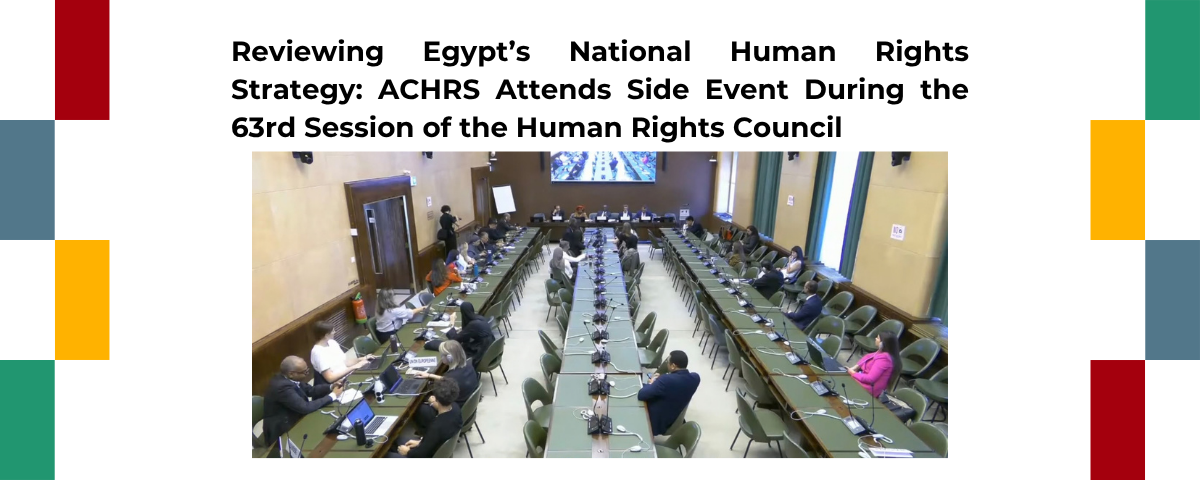
On 14 September, the Amman Center for Human Rights Studies (ACHRS)– represented by Victoria Rebok– attended From Recommendations to Implementation: Civil Society, UN and ACHPR Perspectives on Egypt’s Second National Human Rights Strategy. This high-level side event held on the margins of the 63rd session of the UN Human Rights Council was organised by the Committee for Justice (CFJ), DIGNITY – Danish Institute Against Torture, and the Egyptian Commission for Rights and Freedoms (ECRF).
The event was held in anticipation of Egypt’s Second National Human Rights Strategy, which will set the country’s human rights agenda for 2026–2031. Egypt’s First National Human Rights Strategy was unveiled in 2021 amid significant international scrutiny. Just months before its launch, 32 countries issued a joint statement before the UN Human Rights Council expressing concern over Egypt’s human rights record. Launched in September 2021, the Strategy was subsequently presented as Egypt’s “first comprehensive and long-term self-strategy in the human rights field”. It sought to integrate human rights into Egypt’s broader national development agenda and its “Vision 2030” through four complementary pillars: civil and political rights; economic, social and cultural rights; the rights of women, children, persons with disabilities, youth and older persons; and human rights education and capacity-building. These objectives were to be advanced through legislative and institutional development, alongside greater societal awareness.
However, the outcomes of the first Strategy were mixed, particularly in the area of criminal justice reform. Ahead of its launch, key issues requiring attention included the misuse of emergency legislation; broad counter-terrorism laws used to silence dissent; expansive national security powers; exceptional courts; and state institutions operating without meaningful independent oversight. Five years later, Egypt’s 2021–2026 National Human Rights Strategy had done little to address these structural concerns. Beyond the formal lifting of the state of emergency in October 2021– which did not abolish the Emergency State Security Courts, which continue to hear cases to this day– the Strategy largely reiterated existing legal guarantees and focused on training and institutional initiatives, while treating isolated prisoner releases as evidence of progress.
Eager to see these issues addressed, the CFJ, DIGNITY, and ECRF developed a 2027-2032 Shadow Human Rights Strategy for Egypt. Drawing on consultations with civil society stakeholders, and recommendations issued by UN bodies and the African Commission on Human and Peoples’ Rights (ACHPR), this Shadow Strategy is intended to serve as a benchmark against which Egypt’s Second National Human Rights Strategy may be assessed with respect to criminal justice. The high-level panel held during the 63rd session of the UN Human Rights Council served to launch this report.
Providing an overview of the report, Giorgio Caracciolo of DIGNITY outlined the Shadow Strategy’s six pillars. The first addresses Egypt’s legal framework, calling for the definition of torture to be aligned with international law, enforced disappearance to be criminalised as a standalone offence, terrorism offences to be narrowed, barriers to complaints to be removed, and an independent body established to investigate serious violations by state officials. The second focuses on emergency, counter-terrorism and national-security powers, including reform or repeal of Emergency Law No. 162 of 1958, abolition of Emergency State Security Courts, restoration of ordinary courts’ exclusive jurisdiction over civilians, and a review of security legislation enacted since 2013. The third concerns torture and other ill-treatment, emphasising proper evidence collection, automatic and independent investigations of credible allegations, and accountability for perpetrators. The fourth addresses enforced disappearance, calling for an end to incommunicado detention, prompt and independent investigations, and recognition of families’ rights to truth and information. The fifth focuses on pre-trial detention, urging that it be used only as an exception, an end to “case rotation”, and humane detention conditions. The sixth concerns judicial independence, calling for an end to executive interference, transparent and merit-based judicial appointments, and the abolition of exceptional courts.
Speaking on pillar four, Ms. Aua Baldé from the Working Group on Enforced or Involuntary Disappearances (WGEID) highlighted the pervasiveness of this issue in Egypt. Since the WGEID’s inception in 1980, there have been 917 cases concerning Egypt– 266 of these remain outstanding. A large proportion of cases concern individuals who were ‘only’ disappeared for hours or days– a common practice in Egypt. In this regard, Ms. Baldé emphasised that every deprivation of liberty must be recorded immediately, with detainees being given access to legal counsel and communication. She further underscored that no exceptional circumstance– whether terrorism or war– justifies enforced disappearance.
Most concerning is the Egyptian authorities’ apparent refusal to address the issue. According to Ms. Baldé, Egypt has not replied to the 60 communications regarding cases of alleged enforced or involuntary disappearance transmitted over the past 14 years. Likewise, the WGEID has been unable to conduct a country visit to Egypt since 2011, despite numerous requests. In light of this, and ahead of Egypt’s Second National Human Rights Strategy, Ms. Baldé emphasised that the value of any framework lies in the commitment to its engagement. The Egyptian government must demonstrate willingness to institute changes and stop the widespread practice of enforced disappearances.
Mr. Idrissa Saw, Chairperson of the African Commission on Human and Peoples’ Rights (ACHPR), also echoed this point. He highlighted the ACHPR’s role in meeting with member States and issuing recommendations, while highlighting that it is up to the States themselves to accept these recommendations in good faith. Dr. Litha Musiymi-Ogana, Country Rapporteur for Egypt at the ACHPR, likewise highlighted the difficulties she initially faced when working with Egypt. Assuming her mandate in a moment of profound tension between Egypt and the ACHPR, Dr. Musiymi-Ogana emphasised the importance of keeping avenues for dialogue open. She credits this trust-building approach for her success in securing an ACHPR meeting to the country last year, which offered a chance to assess national efforts aimed at promoting and protecting human rights.
In the spirit of maintaining such dialogue, the event also featured an intervention from Mr. Mohamed Anwar El-Sadat, the Vice-Chair of the Egypt National Council for Human Rights (NCHR). Holding a prominent position in the body tasked with developing Egypt’s Second Human Rights Strategy, Mr. El-Sadat was able to offer a new perspective on the process. He highlighted the NCHR’s engagement with civil society, with consultations taking place between September and October. While welcoming their perspectives, Mr. El-Sadat emphasised the current difficulties facing Egypt, particularly in terms of national security. Underscoring that this was not meant as an ‘excuse’ or ‘justification’ for lack of sufficient human rights progress, Mr. El-Sadat called for a more understanding and constructive dialogue with civil society bodies.
Concluding the panel, Co-Founder and Executive Director of the ECRF, Mr. Mohamed Lotfy, emphasised the value of civil society in bringing in the lived experiences of victims of human rights violations. Such experiences must always remain at the forefront of any National Human Rights Strategy.
The Amman Center for Human Rights Studies (ACHRS) is eager to review Egypt’s Second National Human Rights Strategy, which is set to be published later this year. ACHRS will pay special attention to its provisions regarding enforced disappearance, arbitrary detention, and the death penalty.