Kuwait’s Crackdown on Nationality: ACHRS Attends Side Event During the 63rd Session of the Human Rights Council
By Victoria Rebok
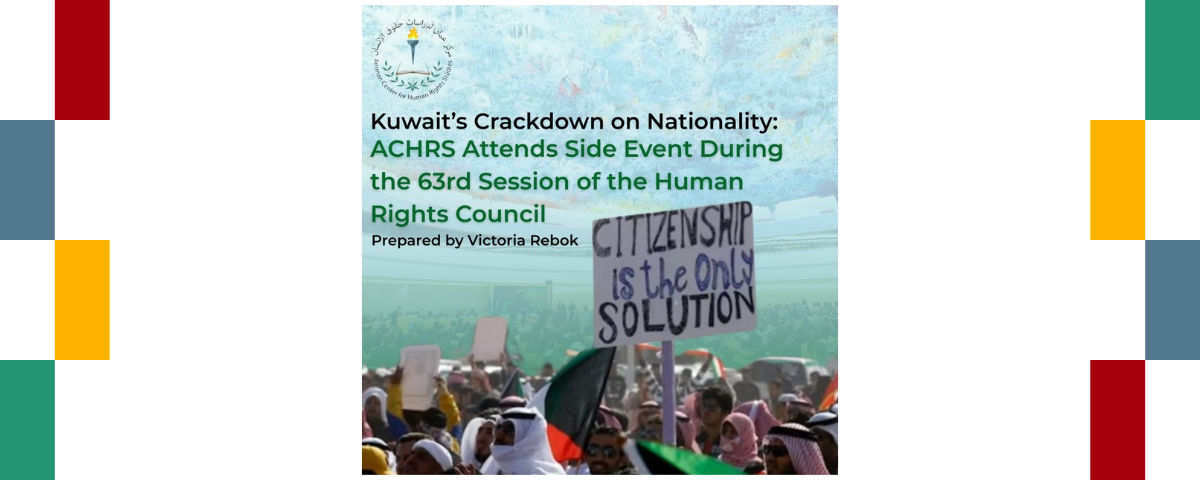
On 16 September, the Amman Center for Human Rights Studies (ACHRS)– represented by Victoria Rebok– attended Kuwait – 70k Stripped of Citizenship: Recent Documentation and Responses. This high-level side event held on the margins of the 63rd session of the UN Human Rights Council was organised by the Gulf Centre for Human Rights (GCHR), SALAM for Democracy and Human Rights (SALAM DHR), MENA Rights Group, Northern Arabian Surviving Indigeneity (NASI) and Amnesty International.
The event marked the launch of the ‘Stateless by Decree: End Kuwait’s Citizenship Stripping Crisis’, authored by SALAM DHR and other organisations through the support of the Global Statelessness Fund. Introducing the report, Mr. Drawers Dyke from SALAM DHR began by emphasising the scale of the problem: since 2024, at least 70,000 individuals have been stripped of their Kuwaiti nationality. Yet this figure captures only a fraction of the problem, as it excludes dependents and family members who have subsequently lost their nationality as a result of the crackdown. Overall, an estimated 300,000 people may have been affected. As Mr. Dyke highlighted, most are women who acquired Kuwaiti nationality through marriage but lost it when their husbands’ nationality was revoked. Because Kuwait prohibits dual citizenship, many had already renounced their original nationality, leaving them Stateless. Children and other dependents have also been affected, with entire families in some cases losing their nationality. The impact is wide-reaching: no longer Kuwaiti citizens, individuals have been denied access to healthcare, education, and even work.
Mr. Mahmoud Shalaby, a researcher at Amnesty International, situated the crackdown on nationality within the broader context of increasing repression in Kuwait following the US-Israeli attacks on Iran. Facing increasing retaliatory strikes by Iran, Kuwait has cracked down on freedom of expression, arresting those who share footage of military facilities or engage in protests. Mr. Shalaby drew particular attention to Kuwait’s new Decree-Law No. 47 of 2026 on Combating Terrorism Crimes, which expands the definition of terrorism and broadens the government’s power to tackle it. Under this new legislation, ‘terrorist acts’ are not only those causing bodily harm, but also those that threaten infrastructure, national interests and security. To combat these so-called ‘terrorist acts’, the Decree-Law establishes new ‘state security’ courts, which hold expedited trials in which defendants are often kept incommunicado and denied access to legal representation. Most concerningly, this new legislation expands the scope of the death penalty as punishment for terrorism offences, in complete violation of requirements under international law that this sentence be reserved for only the most severe of crimes.
As Ms. Farah Sayed from MENA Rights Group highlighted, this legal infrastructure is in complete violation of Kuwait’s obligations under international law. While States do have the right to set their own nationality laws, this power is not unlimited. Broadly speaking, States must ensure that their nationality laws are not arbitrary, not discriminatory, and do not leave someone Stateless. Kuwait’s current crackdown is in violation of all these provisions, particularly as it pertains to the Convention on the Elimination of All Forms of Discrimination Against Women (CEDAW). Ms. Sayed also emphasised that the country’s refusal to engage with international mechanisms on this matter may also constitute a violation of its commitments under international law.
As numerous speakers highlighted, including Mr. Michael Khambatta from the GCHR, Kuwait’s flagrant disregard for international law and norms is particularly concerning considering its membership to the UN Human Rights Council, where member States are required to uphold the highest standards of human rights. Considering Kuwait’s bid for re-election for the 2027-29 term, it is imperative that authorities address this issue and engage with civil society and international mechanisms to resolve it.
The last intervention was made by Mr. Ahmad Benswait from NASI, who spoke about the consistent struggles faced by the Bidoon community in Kuwait. As highlighted in the ‘Stateless by Decree’ report, despite being indigenous to the land, the Bidoon are considered ‘alien’ to the country. Mr. Benswait described how the government’s refusal to grant them nationality hinders the community’s ability to access certain recognitions and services, which are considered ‘privileges’ granted to the Bidoon rather than ‘rights’ to which they are entitled. Those who protest the government’s action often face retaliation and harassment, with the government using family members as leverage against activists abroad.
In this regard, ACHRS remains deeply concerned by the weaponisation of nationality and terrorism laws to silence dissent and restrict freedom of expression. As stated in our written statement to the Council (A/HRC/63/NGO/398) and reiterated during our oral intervention, national security must not be used to justify restrictions on freedom of expression. ACHRS is particularly concerned by the expanded use of the death penalty in this context and will continue to monitor the situation in Kuwait.