Report on the General debate for Item 7: The Human Rights situation in Palestine and other occupied Arab territories
By Romina M. Iramloo
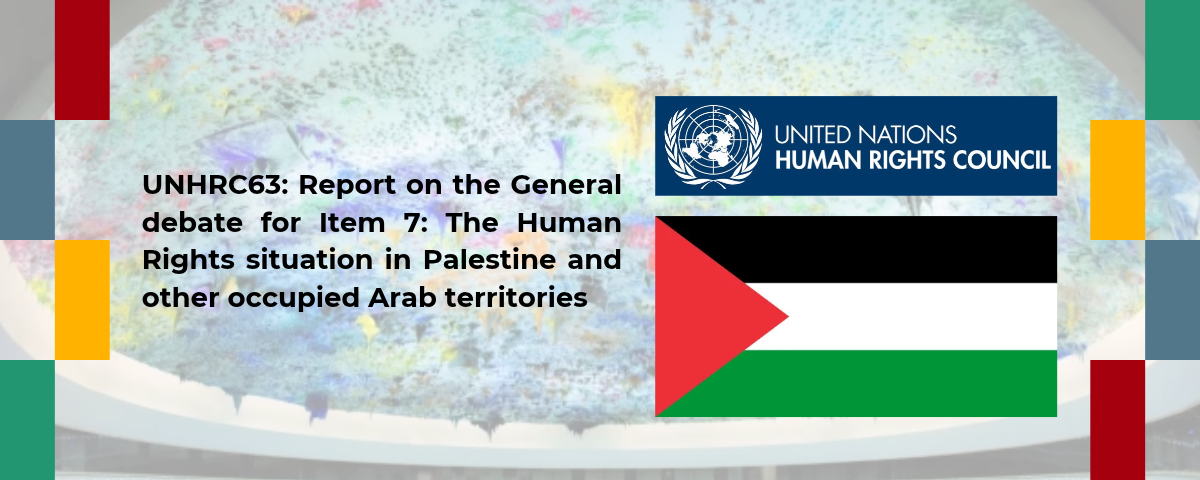
On the 29th of September 2026, the Amman Center for Human Rights Studies (ACHRS) participated in the 63rd Human Rights Council in Geneva for the General Debate on Item 7 regarding the “Human Rights Situation in Palestine and Other Occupied Arab Territories”, represented by Coordinator Filipe Dias Kalgaard and Human Rights and Advocacy Intern Romina M. Iramloo.
The discussion focused on the continuing deterioration of the human rights situation in Palestine, particularly in occupied Gaza and the West Bank, and on the broader consequences of the prolonged occupation. For ACHRS, the situation cannot be understood only through individual incidents of violence. It must also be understood through the structures and policies that have made displacement, restricted movement, insecurity and the denial of basic rights part of everyday life for Palestinians.
One of the central issues raised was the ongoing genocide in Gaza. Despite repeated announcements and agreements regarding a ceasefire, which have raised hopes among Palestinians that the violence may finally come to an end, these hopes have repeatedly been met with the reality of continued suffering. During the council, the Palestinian delegate stressed that “there is no ceasefire, although there have been several agreements”. For ACHRS, this reveals the gap between political declarations and the reality experienced by civilians on the ground. A ceasefire must mean more than an announcement. It must provide civilians with genuine safety. Therefore, ACHRS strongly calls for an immediate and lasting ceasefire and, importantly, for unrestricted humanitarian access to Gaza. The humanitarian crisis cannot be separated from the destruction of homes, infrastructure and civilian life, as if Palestinians haven’t been through enough suffering throughout the decades of occupation perpetuated by “Israel”. Palestinians must be given the opportunity to rebuild their communities and live ordinary lives in circumstances that have been anything but ordinary. Humanitarian assistance should not be treated as a political bargaining tool, but as a necessity for a population facing an immense humanitarian crisis.
The situation in the occupied West Bank was another major concern raised during the council. After decades of occupation and struggle, it is no longer enough to simply discuss the situation on a global stage. Palestinians need action and change. ACHRS condemns the continued expansion of settlements, the confiscation of Palestinian land and the displacement of families from homes in which generations have lived. Violence by settlers, forced removals and the destruction or stealing of property do not only affect individuals in the moment; they contribute to a wider process in which Palestinians are becoming ethnically cleansed and pushed away from their homes.
We are particularly concerned by the lack of accountability for violence committed by terrorist settlers. Palestinians cannot be expected to have confidence in a system of justice when those responsible for violence and intimidation are not adequately investigated or ever held accountable. The right to security and equal protection under the law must belong to everyone. Yet for Palestinians, impunity has become part of a reality they have been forced to live with for far too long. We emphasise that justice therefore cannot remain a promise; it must become a reality.
Restrictions on movement were also discussed. Checkpoints and other forms of movement control are repeatedly justified in the name of “security”. However, ACHRS questions the extent to which “security” can be used to justify restrictions that so extremely interfere with the everyday lives of Palestinians. A journey that would ordinarily take twenty minutes can become several hours because of checkpoints and delays. People are prevented or delayed from reaching work, education, healthcare, family members and other essential parts of everyday life. For us, this is not simply a question of inconvenience. The language of securitisation must therefore not be used to normalise policies to restrict Palestinians’ freedom and contribute to their exclusion from ordinary social and economic life.
ACHRS also raised concerns regarding the expansion of policies that permit the death penalty against Palestinians. The use of criminal justice and punishment must comply with international human rights standards and cannot be applied in ways that reinforce unequal treatment and contribute to ethnic cleansing.
The discussion also addressed developments beyond the Palestinian territories. ACHRS condemns Israel’s continued expansion of its territorial and military presence in Syrian territory, including the occupied Golan Heights. For ACHRS, such actions further contribute to displacement, create an unstable region, and undermine respect for international law and the territorial integrity of Arab states.
ACHRS believes that the international community cannot remain passive in the face of these developments. International institutions, including the ICJ, must continue to investigate alleged violations and ensure that those responsible are held accountable. Accountability is essential because without consequences, violations risk becoming normalised and repeated. ACHRS therefore calls on states to take meaningful action, including political and economic measures against Israel, and to use their influence to pressure for an end to the occupation, protection of civilians and respect for international law. The responsibility to protect human rights should not depend on political alliances or geopolitical interests. At the centre of ACHRS’s position is the belief that Palestinians have the right to live with dignity, freedom and security in their own homeland. The Palestinian people have the right to self-determination and to a sovereign state. A sustainable future cannot be built on continued occupation, displacement, unequal treatment and restrictions on everyday life. These are not extraordinary demands. They are basic human rights.
Our Center therefore urges the international community to employ appropriate methods to sanction the Zionist regime for its violations of international law. We thank the following states for imposing sanctions last month on Israeli settlements: Canada, Denmark, Finland, France, Iceland, Ireland, Norway, Poland, Portugal, Spain, Sweden and United Kingdom.
To read as PDF, click here