Statement on Child Protection and Legal Rights for Vulnerable Children in Jordan
Prepared by Jwana Loqman
Statement on Child Protection and Legal Rights for Vulnerable Children in Jordan
Date: 12 October 2026
Prepared by Jwana Loqman
To read as PDF, click here
The Amman Center for Human Rights Studies (ACHRS) expresses its sincere gratitude to the Arab Renaissance for Democracy and Development (ARDD) and Terre des Hommes Italy (TdH Italy) for inviting our organization to participate in this important roundtable discussion on child protection and legal protection needs in Jordan.
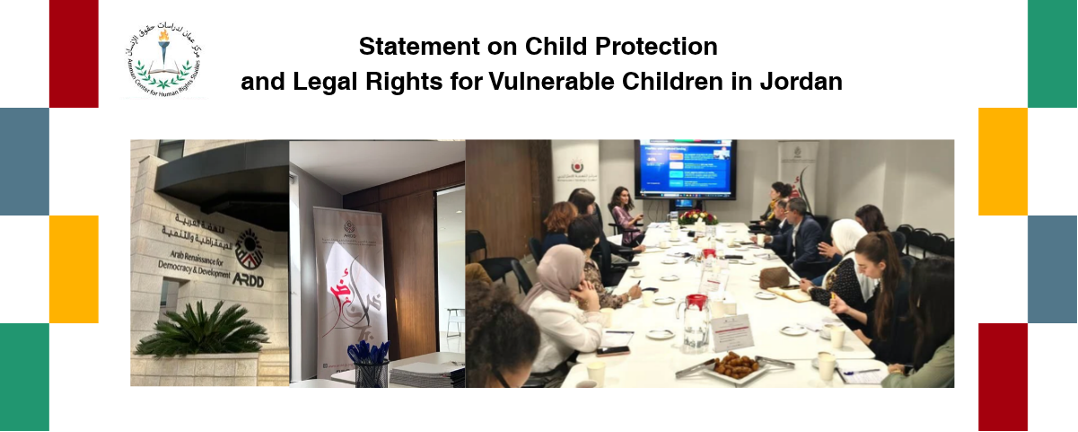
The event, held on October 8, 2026, in Al Jaabri Hall at ARDD’s headquarters in Amman, brought together key stakeholders to address critical human rights issues facing vulnerable children. ACHRS was represented at the meeting by interns Lisa Tassi, Amina Alayout, Elli Klimathianakis, and Jwana Loqman.
The discussion examined the findings and recommendations of the joint research report, “Intersecting Risks and Rights: Child Protection and Legal Protection Needs in Jordan.” Drawing on field research conducted in Amman, Mafraq, Zarqa, and Ma’an, the report highlighted the challenges and risks facing children in communities across Jordan, with economic hardship identified as a major factor affecting children’s safety and access to basic services.
According to the findings presented, 89% of households experience economic pressure, contributing to a higher risk of child labour among refugee children (19%) than among children in host communities (3%). Child labour was reported mainly in street vending and agriculture. Financial difficulties also increase the risk of early marriage, with 5.1% of children reported to be at risk. Economic pressures further affect school attendance, which stands at 70%. Safety in public spaces is another concern, with 97% of children reporting that they feel unsafe and 26% facing unsafe routes to school.
The effects of displacement and prolonged exposure to difficult circumstances also have serious consequences for children’s mental and psychosocial well-being. Parents reported concerns including difficulties concentrating, anxiety, panic episodes, and sleep disturbances. According to the findings, 78% of households reported that their children needed professional psychosocial support. Children with disabilities face additional challenges, as physical, cognitive, and social barriers can limit their access to education and prevent their full participation in inclusive learning environments.
The lack of civil documentation, as well as errors or inconsistencies in existing records, presents another significant barrier to children’s rights. These issues can delay school enrolment and restrict access to healthcare and social services. Differences between registration systems and naming conventions can also create difficulties when verifying a child’s identity, particularly when Jordanian registration practices do not align with family naming traditions. Access to legal aid is therefore essential to help families resolve documentation issues and ensure that children’s right to legal identity is protected, in accordance with Article 24 of the International Covenant on Civil and Political Rights and Article 7 of the Convention on the Rights of the Child.
The challenges facing children are compounded by a reported 84% reduction in international humanitarian funding for Jordan between 2024 and 2026, from $473 million to $76 million. This decline threatens the continuity of essential protection services, legal aid, case management, and specialized psychosocial support. Reduced funding also places additional pressure on organizations working to reach vulnerable children and their families.
During the roundtable, participants, including ACHRS representatives, highlighted four priorities for strengthening child protection in Jordan. These included improving civil registration procedures to prevent documentation gaps and reduce the risk of Statelessness; expanding community-based legal aid and raising awareness of civil rights and court procedures; maintaining coordinated case management to address child labour and ensure access to psychosocial support; and developing sustainable funding models that connect immediate humanitarian assistance with longer-term development goals.
ACHRS calls for:
- Ensuring flexible civil registration: simplify birth registration to guarantee every child’s right to a legal identity, regardless of nationality or naming traditions;
- Guaranteeing safe, inclusive education: remove financial barriers, improve route safety, and adapt infrastructure for children with disabilities;
- Strengthening child protection and psychosocial care: expand targeted social protection to prevent child labor and early marriage, while integrating mental health support for displacement trauma;
- Countering aid cuts with long-term funding: mobilize predictable donor support to address the 84% humanitarian funding shortfall, securing the continuity of essential legal aid, psychosocial care, and civil society protection services;
The Amman Center for Human Rights Studies (ACHRS) remains committed to promoting and protecting the rights of vulnerable children in Jordan. Working alongside national authorities, international partners, and civil society organizations, ACHRS supports efforts to ensure that every child, regardless of nationality or legal status, can grow up in a safe environment and enjoy their fundamental rights.