ACHRS participated virtually in the 44th Annual Conference of Human Dignity and Humiliation Studies, held at the University of Hamburg.
By Victoria Rebok
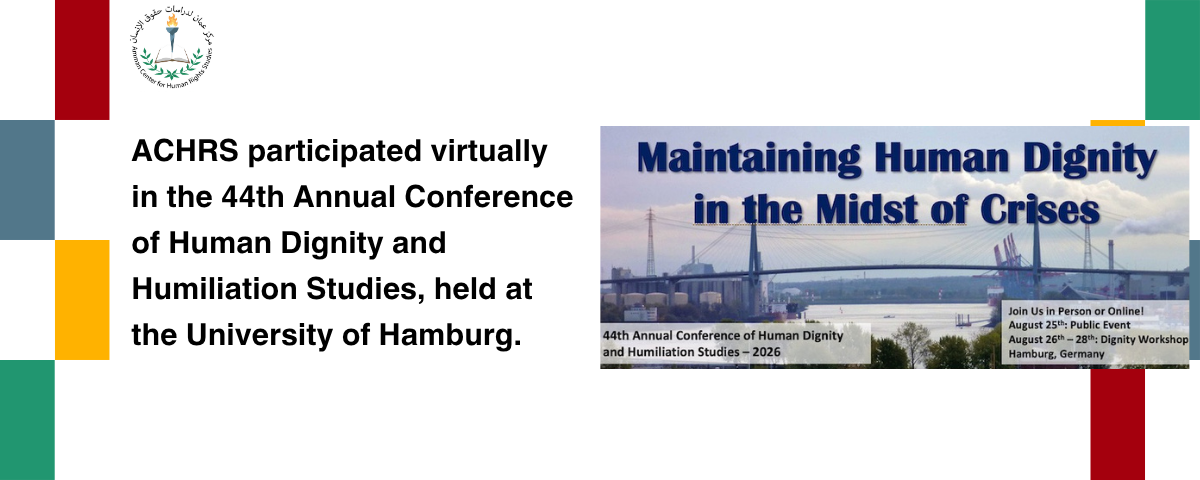
On 25 August 2026, the Amman Center for Human Rights Studies (ACHRS), represented by Victoria Rebok, participated virtually in the 44th Annual Conference of Human Dignity and Humiliation Studies, held at the University of Hamburg.
In recognition of the many crises affecting our world, this year’s conference aptly centered on the theme of ‘Maintaining Human Dignity in the Midst of Crises’. Joining online, Professor Claus Krieger emphasised that this theme was far from coincidental: human dignity is inextricably linked to peace. It is therefore imperative that we do not treat dignity as an abstract concept, but as a principle that must be actively upheld and practiced. The conference focused primarily on children and adolescents, who are the foremost victims of humiliation and violations to dignity. While these are often understood in their most extreme forms, Professor Dr. Alexander Redlich explained that violations of dignity can be as seemingly simple as communicative humiliation, including verbal attacks. This is particularly pertinent in the age of social media, where such attacks can be rapidly amplified.
Dr. Kerstin Stellermann-Strehlow’s presentation further highlighted the profound impact that such humiliation can have on a child’s psychological well-being and development. She explained that trauma can be understood as a form of extreme stress, while emphasising that individuals have different thresholds for what they experience as traumatic and, consequently, different psychological responses to it. Trauma therapy therefore seeks to help children and adolescents move beyond these survival states through validation, memory reconsolidation, and the development of secure, supportive relationships. Such work is crucial at a communal level, as it prevents a desire for restoration of dignity to be turned into a desire for domination. In this way, trauma therapy is peace work.
Given the importance of trauma therapy not only to long-term individual well-being, but also to fostering positive intercommunal relations and sustainable peace, ACHRS is deeply concerned by the limited availability of mental health services for those most affected by crisis and conflict. Recent reports indicate that UNHCR’s Mental Health and Psychosocial Support (MHPSS) programmes are under increasing strain due to funding shortfalls. As stand-alone programmes become increasingly difficult to sustain, MHPSS must instead be integrated into national health systems in host states. This presents significant challenges, however, as many of the countries hosting the largest refugee populations have underdeveloped mental health systems.
Jordan, which hosts 445,000 refugees and asylum seekers registered with UNHCR– although the actual number, including those who are unregistered, is believed to exceed one million– is one such country. While Jordan’s mental health system has undergone significant improvements following the implementation of the WHO’s Mental Health Gap Action Programme (mhGAP), substantial gaps remain, particularly in ensuring that people are able and willing to access mental health services. Stigma remains a key barrier to access, and one that mhGAP programmes have yet to comprehensively address.
ACHRS therefore calls on governments to strengthen and integrate mental health services within national health systems, with particular emphasis on ensuring that trauma-informed care is both accessible and responsive to the needs of those most affected by crisis and conflict. This requires sustained investment in programmes such as the WHO’s Mental Health Gap Action Programme (mhGAP) and its humanitarian intervention guide (mhGAP-HIG), while recognising that expanding service provision alone is insufficient. Governments must also address the stigma and social barriers that prevent individuals from seeking and receiving care, including through targeted awareness and community-based initiatives in refugee-hosting communities and camps.