From national protests to transnational mobilisation?
Written by Elli Klimathianakis
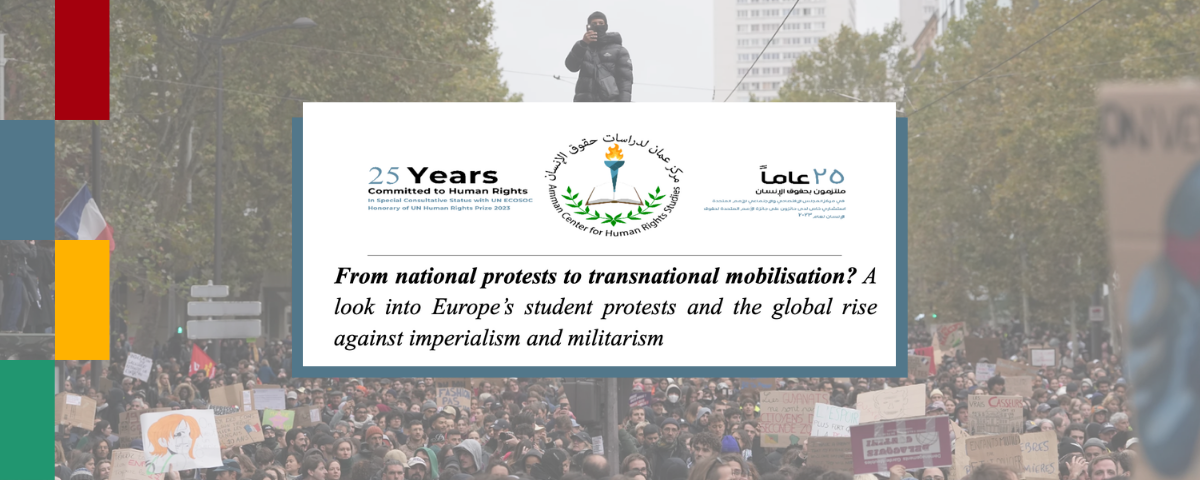
From national protests to transnational mobilisation? A look into Europe’s student protests and the global rise against imperialism and militarism
To read as PDF, click here
The Amman Center for Human Rights Studies (ACHRS) is a human rights research and advocacy centre based in Amman, Jordan, dedicated to promoting democratic principles and advancing human rights across the Arab region. Guided by these commitments, ACHRS recognises the right to participate in public affairs as an essential component of a democratic society. This right encompasses the ability of individuals and groups to express their views, engage in protest, organise collectively, and contribute meaningfully to decisions that affect their lives and communities.
In this context, we raise important questions about the relationship between civic mobilisation, political accountability, and the exercise of the right to participate. By examining student-led protests and broader social movements across Europe and beyond, we want to highlight the significance of public expression and collective action in challenging the status quo, while drawing attention to the tensions that arise when state responses restrict civic space or fail to address public demands.
Introduction
A wave of widespread unrest has swept across large parts of Europe, with demonstrations erupting in France, Italy, Spain, Portugal, Greece, Albania, Belgium, Germany, Serbia, Austria, and Ireland. These protests have unfolded against the context of a deepening affordability crisis, deteriorating working conditions, declining educational standards, and a broader, increasingly pervasive sense of political and economic ras-le-bol; a generalised frustration with the status quo and the institutions perceived to be upholding it (Hecimovic 2026). Our generation is bearing witness to a transnational wave of protests driven by overlapping grievances. Taking the French student protests of late September 2026 as a point of departure, we examine our current generations’ political lassitude by situating the French protests within a broader European landscape of unrest, exploring how distinct national struggles intersect around shared frustrations.
Originating in Paris’s northern suburbs, the movement gained amplitude challenging education cuts, overcrowded classes, staff shortages, dilapidated classrooms and an opaque university admissions system (Chrisafis 2026). Although student unrest across Europe has been brewing, France’s latest wave of protests electrified the continent’s discontent into sharper focus (Taylor and Kassam 2026). The French protests escalated into one of the most violent episodes the country had experienced in recent years, reaching a peak on Saturday, 17 October, when approximately 800,000 people rallied against the rising cost of living, alongside students demanding better conditions in their schools. The demonstrations were accompanied by widespread confrontations and violence, resulting in approximately 1,200 arrests. Police deployed tear gas, water cannons, and batons against demonstrators, while small groups smashed shopfronts, looted stores, and set objects ablaze. The scale of the police response, however, drew renewed scrutiny following reports of serious injuries among demonstrators, including a teenager losing his hand to a stun grenade. The police watchdog subsequently opened investigations into at least two dozen allegations of police violence given its excessive use of force (Laizans, Prousalis and Tessier 2026).
Societal discontent is hardly a novel phenomenon. Yet the current period may mark the emergence of a renewed “revolutionary” ethos among European youth, one that increasingly transcends national borders. The demonstrations of October 2026, despite emerging from distinct national contexts, are interconnected by an increasingly common target of discontent. At the heart of this malaise lies a fundamental question about the allocation of public resources. How can governments justify the rising cost of living, persistent housing shortages, and chronically underfunded public services at home while expanding military expenditure, pursuing lucrative investment deals, and continuing to privilege market interests over citizens’ well-being? These tensions point towards a broader disillusionment with a neoliberal model of governance in which economic competitiveness, private accumulation, and strategic interests are frequently prioritised over social security and collective welfare (Cingari 2025).
Beyond Europe’s Affordability Crisis: The Deeper Roots of Europe’s Protest Movements
Albania offers a particularly insightful example of how these grievances intersect with questions of political accountability and economic inequality. Last summer, protests erupted over a luxury coastal development backed by Jared Kushner, Donald Trump’s son-in-law. More recently, demonstrations against Prime Minister Edi Rama entered their seventh consecutive day on Monday, as protesters voiced frustration over corruption, limited employment opportunities, and declining educational standards (Taylor and Kassam 2026). Although these mobilisations have their own immediate causes, they reflect a wider struggle over who benefits from political and economic decision-making, and whose needs are left unmet.
Spain provides a stark illustration of how soaring housing costs have fuelled public discontent. In September, protests were sparked by the eviction of 87-year-old Maricarmen Abascal after an investment fund reportedly increased her rent by 230%. Abascal died two weeks later, but her case became emblematic of the human cost of a housing market increasingly shaped by investment interests and rising rents. Protesters called for rent freezes, a halt to evictions affecting vulnerable tenants, and tighter regulation of short-term and room rentals. Similar pleas were made in Portugal on Saturday, 17 October, when hundreds gathered in central Lisbon. Portuguese housing prices more than doubled between 2015 and 2024, roughly twice as fast as the EU average, according to official data, one of the worst affordability crises in Europe. In Italy, meanwhile, squeezed household budgets were among the central grievances behind demonstrations in Milan (Taylor and Kassam 2026).
By 17 October, however, it had become clear that the mobilisation extended well beyond deteriorating educational conditions and the rising cost of living. In Paris, students’ grievances converged with those of workers, pensioners, and other demonstrators angered by soaring prices. The General Confederation of Labour, one of France’s largest trade unions, threw its support behind the mobilisation. What had initially begun as a student-led struggle had thus evolved into something broader, reflecting a growing disillusionment with the political and economic priorities of European governments. Other demonstrators joined the marches, voicing their discontent over fuel prices after US bombing in effect caused the closure of the strait of Hormuz (Taylor and Kassam 2026).
Against the backdrop of an increasingly militarised European political landscape, with Trump’s pressure on NATO allies to increase defence spending, anti-militarism is not necessarily a standalone cause of mobilisation but part of a broader critique of a political order perceived to place geopolitical ambitions and strategic interests above the everyday needs of its citizens.
The convergence of socioeconomic grievances and anti-militarist politics is therefore neither implausible nor incidental. Spain illustrates the intersection between its domestic socioeconomic situation and international political solidarity. The occupation of Madrid’s Puerta del Sol in October 2026, initially driven by the lack of affordable housing, brought together a diverse network of organisations addressing housing rights, labour conditions, education, environmental issues, and even Palestine. The encampment’s network included 46 collectives, among them housing organisations such as the Sindicato de Inquilinas and Palestine-solidarity groups including Acampada x Palestina and Global Sumud Spain. Although this overlap does not establish a unified political agenda, it provides a concrete example of how domestic socioeconomic discontent and international solidarity can converge within a shared space of protest (El Confidencial Digital 2026).
This interconnectedness is also reflected in efforts to coordinate labour action across national borders. The International Day of Action announced for 30 October 2026 by Mediterranean and European dockworkers’ unions offers a concrete example of cross-border labour coordination. By opposing the transport of military supplies to conflict zones and the militarisation of port infrastructure, while also demanding higher wages, secure employment and improved working conditions, participating unions bring geopolitical concerns into direct conversation with workers’ everyday interests (World Federation of Trade Unions). Their mobilisation suggests that opposition to militarisation need not be separate from struggles over wages, employment and living standards; rather, these demands can form part of a broader challenge to political and economic priorities.
Palestine at the Heart of Transnational Mobilisation
In its announcement of the 30 October action, the WFTU explicitly linked opposition to militarisation and the arms trade with solidarity for Palestine and other peoples affected by conflict and occupation. Its demands included an “immediate end to the genocide of the Palestinian people” and recognition of an independent Palestinian state, alongside an end to military aggression in West Asia. The statement also called for ports to be closed to the transport of arms and military equipment destined for conflict zones. Crucially, these geopolitical demands were articulated alongside calls for wage increases, job security, reduced working hours, and fair pension. This frames opposition to war and militarisation not as a separate political concern, but as part of a broader struggle over the allocation of public resources and the conditions of workers’ lives. Its call to redirect public resources towards social needs rather than war further illustrates how solidarity with Palestine is connected to wider demands for economic and social justice (WFTU, 2026).
According to the WFTU, the action involved more than 25 trade union organisations, with mobilisations planned across 113 ports in 22 countries and regions, spanning five continents. The organisation also connected the dockworkers’ action to the wider wave of protests taking place across Europe, where demonstrations addressed both the rising cost of living and opposition to involvement in foreign wars (WFTU, 2026; Middle East Eye, 2026). In this sense, the mobilisation brought together workers’ demands for better pay and conditions with opposition to arms shipments to Israel amid its war on Gaza, as well as other military actions, including the war on Iran. Its significance therefore lies in the connections it established between struggles that are often treated separately: workers’ rights, the cost of living, opposition to militarisation and solidarity with Palestine. The immediate economic impact of the action remains difficult to establish. Reuters reported that 52,000 containers had been halted, representing an estimated $2.8 billion worth of cargo that could not move, while Labour for Palestine estimated the cost of the disruption at up to $57 million (Reuters, 2026; Labour for Palestine, 2026).
Beyond Europe: From Local Grievances to Global Discontent
Now, as French President Emmanuel Macron approaches the end of his second and final term at the Élysée Palace amid persistently low public approval, the question remains whether the latest wave of protests will produce meaningful political or socioeconomic change. Following 17 October 2026, the French government reportedly maintained and extended curfews in several major cities, including Paris, Lyon, Bordeaux, Lille and Nice. The measures prompted criticism from citizens concerned about restrictions on personal freedoms and the failure to adequately address protesters’ frustration (France24 2026). This response encapsulates the central tension of maintaining an increasingly unsustainable status quo, rather than addressing collective well being.
Nor is this discontent confined to Europe. Across Asia, Africa and Latin America, a growing number of protests have reflected similar frustrations with economic insecurity, limited opportunities, inadequate public services and political accountability. The recent wave of Gen Z-led mobilisations in countries including Nepal, Indonesia, Morocco and India, for instance, has brought young people onto the streets to challenge corruption, unemployment, the cost of living and the failure of political institutions to respond to their concerns (BBC, 2026). Similar frustrations have also fuelled demonstrations over rising living costs in countries such as Senegal and Costa Rica, suggesting that economic discontent is not limited to the European context (Al Jazeera, 2026). In Brazil, these developments have unfolded alongside a highly contested electoral climate. On 25 October, Lula da Silva secured re-election with 51.79% of the valid vote, following a campaign marked by extensive online and street mobilisation, including demonstrations organised by social movements and students across dozens of cities (Tribunal Superior Eleitoral, 2026; Agência Brasil, 2026). Although these movements have emerged from distinct national and political circumstances, their overlapping demands point to a broader pattern of discontent.
From affordable living and decent employment to accessible education, public healthcare and political accountability, protesters are increasingly challenging whose interests political institutions ultimately serve. In some contexts, these grievances also intersect with opposition to militarisation and foreign military intervention. Perhaps, then, the emerging picture is that of a widening crisis of political legitimacy in which established priorities are increasingly contested. Whether this discontent develops into sustained political transformation, is channelled into electoral change, or is contained through repression and temporary concessions remains uncertain. Ultimately, the significance of this wave of protest will depend not simply on how many people take to the streets, but on whether their demands translate into lasting changes and whether governments respond to them by addressing its causes rather than merely managing its symptoms.
References
Anagnostopoulou, Valentini. 2026. “Dockworkers strike in Europe and beyond against arms shipments, war deaths.” Reuters. https://www.reuters.com/business/world-at-work/dockworkers-strike-in-europe-beyond-against-arms-shipments-war-deaths-2026-10-30/.
Bhattacharya, Payal, Pragya Srivastava, and Rupanjal Chauhan. 2026. “Cold Stats, Warm Spirits: Inside the Genz Z protest that redefined India.” Mint, July 26, 2026.
Chrisafis, Angelique. 2026. “’We’re not asking for luxury’: school protesters in Paris suburb feel abandoned by French state.” The Guardian, October 10, 2026. https://www.theguardian.com/world/2026/oct/10/school-protesters-sevran-paris-suburb-france.
Cingari, Piero. 2025. “Trump at Davos: NATO 5% push, tariff warnings for Europe.” Euronews, January 23, 2025.
Euronews.com. n.d. “”Não voto em quem vende o Brasil”: milhares de estudantes em manifestação pró-Lula no Rio de Janeiro.” Accessed October 26, 2026. https://pt.euronews.com/2026/10/08/nao-voto-em-quem-vende-o-brasil-milhares-de-estudantes-em-manifestacao-pro-lula-no-rio-de-.
France 24. 2026. “France : première nuit sous couvre-feu dans certaines villes.” October 20, 2026. https://www.france24.com/fr/vid%C3%A9o/20261020-france-premi%C3%A8re-nuit-sous-couvre-feu-dans-certaines-villes.
Hecimovic, Arnel. 2026. “From Paris to Porto, from Tirana to Milan: protests across Europe – in pictures.” The Guardian, October Tuesday 20, 2026. https://www.theguardian.com/world/gallery/2026/oct/20/from-paris-to-milan-student-protests-across-europe-in-pictures.
“International Day of Action of Dockworkers and Port Workers against war and militarization – 30 October 2026.” 2026. World Federation of Trade Unions. https://www.wftucentral.org/international-day-of-action-of-dockworkers-and-port-workers-against-war-and-militarization-30-october-2026/.
Laizans, Janis, Stamos Prousalis, and Yann Tessier. 2026. “Mass protests in France spiral into worst riots in years.” Reuters. https://www.reuters.com/world/students-trade-unions-yellow-vests-set-protest-across-france-2026-10-17/.
“Los 46 colectivos que protagonizan la web de la acampada de Sol.” 2026. El Confidencial Digital. https://www.elconfidencialdigital.com/articulo/el-chau-chau/46-colectivos-que-protagonizan-web-acampada-sol/202610090500001492086.html.
Pilichowski, Uri. 2026. “France’s Student Protests Reveal How the Palestinian Cause Became a Symbol of Western Rebellion.” MidEast Journal. https://www.mideastjournal.org/post/france-student-protests-palestinian-flags.
Taylor, Harry, and Ashifa Kassam. 2026. “Why are people protesting across Europe? | Protest.” The Guardian, October 18, 2026. https://www.theguardian.com/world/2026/oct/18/europe-protests-france-spain-portugal-2026-explainer.
“USB: ONE MILLION TAKE TO THE STREETS AGAINST WAR AND THE COST OF LIVING.” 2026. World Federation of Trade Unions. https://www.wftucentral.org/usb-one-million-take-to-the-streets-against-war-and-the-cost-of-living/.
“Dockworkers across 100 ports in 22 countries went on strike…” n.d. Middle East Eye. https://www.instagram.com/reels/DfKKXUsCcE5/.
“30th October International day of action: ‘Dockworkers don’t work for war.’” 2026. Labor for Palestine. https://laborforpalestine.net/2026/10/30/30th-october-international-day-of-action-dockworkers-dont-work-for-war-no-harbour-for-genocide/.
“Why is Gen Z protesting around the world?” 2026. BBC. https://www.bbc.co.uk/news/videos/cjzxlp96n36ko.
“Alongside economic protests in European countries, rising living costs are fueling frustration in other nations too...” 2026. AlJazeeraenglish. https://www.instagram.com/reels/DewkpK2iHfv/.
“Presidente do TSE anuncia reeleição de Lula e faz balanço do 2º turno das Eleições 2026.” 2026. Tribunal Superior Eleitoral. https://www.tse.jus.br/comunicacao/noticias/2026/Outubro/presidente-do-tse-anuncia-reeleicao-de-lula-e-faz-balanco-do-2o-turno-das-eleicoes-2026.
“Lula reelected president of Brazil in historic comeback.” n.d. Agência Brasil. Accessed November 2, 2026. https://agenciabrasil.ebc.com.br/en/politica/noticia/2026-10/lula-re-elected-president-brazil-historic-comeback.