Human Rights Council: Equal participation of persons with disabilities in political life
Written by Ayla Qawas
Download the full article here
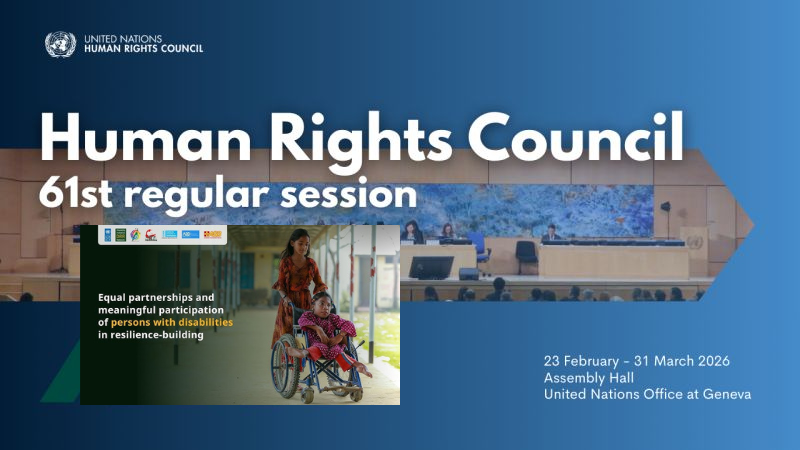
The Amman Center for Human Rights Studies (ACHRS) continues to monitor and engage with developments within international human rights mechanisms, particularly those aligned with its priorities. In January 2026, the Office of the United Nations High Commissioner for Human Rights (OHCHR) published a thematic report to the 61st session of the United Nations Human Rights Council examining the equal participation of persons with disabilities in political and public life. The report builds on previous OHCHR work addressing the rights of persons with disabilities and was submitted in accordance with Human Rights Council resolution 53/14.
This issue remains critical in enhancing inclusive governance and aligns with overarching issues around equality, participation, and non-discrimination, especially in ensuring that no one is left behind in political and democratic processes.
Political Participation as a Rights Issue
The report presents political participation not simply as a civic opportunity, but as a fundamental human rights obligation. It emphasizes that participation in political and public life is essential to ensuring equality, dignity, and inclusion for persons with disabilities.
This framing reflects a broader shift in international human rights discourse, where participation is understood as a prerequisite for inclusive governance rather than an outcome of it.
Persistent Barriers to Participation
Despite international legal frameworks, the report highlights that persons with disabilities continue to face significant barriers in exercising their political rights.
These include inaccessible voting procedures, limitations in access to information, and legal restrictions that may prevent individuals—particularly those under guardianship—from voting or standing for election. Such barriers demonstrate the gap between formal recognition of rights and their practical implementation.
Participation Beyond Voting
The report has expanded our understanding of what political participation means. It has reinforced the significance of inclusion in:
- decision-making in public affairs
- political parties and institution
- leadership and representation
This shows that there cannot be participation if one is not actively involved in all spheres of life.
Structural and Attitudinal Challenges
The report further identifies structural and societal factors that continue to limit participation. These include stigma, lack of awareness, and insufficient provision of reasonable accommodation and support systems.
Such challenges highlight the need for systemic approaches that address both institutional barriers and social attitudes toward disability.
Key Takeaways
- Political participation: The report has reinforced political participation as a rights issue.
- Gaps in implementation: The report has shown that there remains a gap between rights being recognized and rights being implemented.
- Participation: The report has shown that there cannot be participation if one does not actively engage in all spheres of life.
- Intersection of barriers: Structural and attitudinal factors continue to reinforce exclusion.
The report has added some insights to the ongoing debate in the Human Rights Council. It has reinforced that equal political participation for persons with disabilities remains one of the critical issues that has yet to be realized.