Human Rights Council: Human Rights Situation in the Occupied Palestinian Territory, including East Jerusalem
Written by Tshepo Tlhacoane
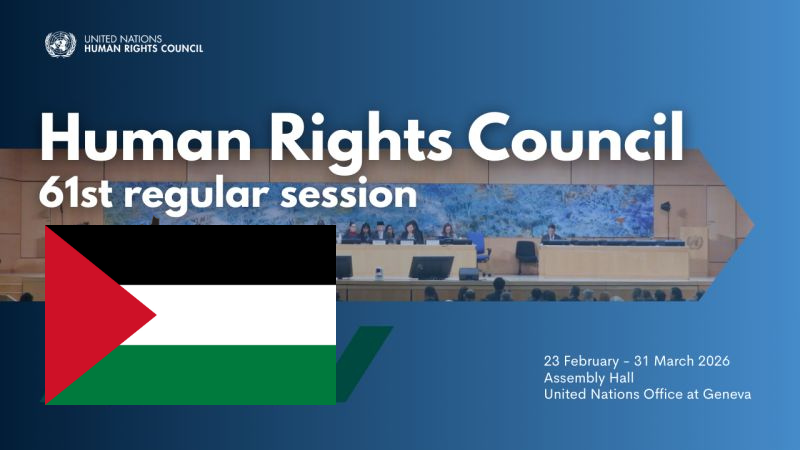
Human Rights Council Agenda item 2: Human Rights Situation in the Occupied Palestinian Territory, including East Jerusalem
The Human Rights Council convened in Geneva for its 61st Session, which will run between 23 February and 31 March 2026. Agenda item 2 dealt with the report, Human rights situation in the Occupied Palestinian Territory, including East Jerusalem and the obligation to ensure accountability and justice, pursuant to Human Rights Council resolution 58/2. The report, which was based on the human rights monitoring of the United Nations Office of the High Commissioner for Human Rights (OHCHR), predominantly covers the period between 1 November 2024 and 31 October 2025, and is based on information from governmental sources, other United Nations agencies, and non-governmental organizations.
The report discusses the human rights situation in Palestine during the abovementioned reporting period, and found there to be gross violations of international humanitarian law and international human rights law. The report found that hostilities continued to kill large numbers of non-combatants, damaged civilian infrastructure, caused widespread displacement, led to the arbitrary detention and torture of civilians, attacks on journalists, and that there was little accountability against the perpetrators of these actions.
Hostilities in Gaza
During the reporting period, there were at least 25,594 Palestinians killed, and another 68,837 injured in Gaza. The death toll is likely to be higher as it does not account for those who are buried under rubble. During this period, there were no confirmed Israeli citizens that were injured or killed in Gaza.
As of 7 October 2025, 20,179 children had been killed in Gaza over the preceding 2 years, an equivalent of a classroom of children killed every day during this period. According to the report, Gaza now has the highest number of amputee children per capita in the world.
Israel continues to attack residential buildings, which are not military targets, as is required by international humanitarian law. OHCHR recorded 1,993 attacks on residential buildings during the reporting period, resulting in 4,528 fatalities.
The use of Unmanned Aerial Vehicles (UAV) with advanced surveillance capabilities have been used to kill civilians in a manner that does not advance a lawful military objective. OHCHR recorded at least 1,143 attacks in which UAVs were implicated, resulting in the deaths of 2,097 Palestinians.
Israel’s militarization of humanitarian assistance in Gaza also led to widespread unlawful killings. Between 27 May and October 8 2025, 2,435 Palestinians were killed by Israeli armed forces while trying to access food.
The killings did not stop during the two ceasefires of 2025. In the ceasefire between 19 January and 17 March 2025, the Israeli military killed 81 Palestinians, many by UAVs, while 50 Palestinians were killed after the ceasefire that entered into force on 10 October 2025.
Israel issued displacement orders frequently during this reporting period, and by 31 October 2025, 1.9 million people, approximately 90% of the population of Gaza, remained displaced. The report asserted that Israel’s actions indicated the mass forcible transfer of the population, as the frequent, repeated orders did not appear to be required for a military operation, nor were they genuinely issued for the security of the population.
Displacement in Gaza has, in large part, been driven by the destruction of civilian infrastructure needed to support Palestinian life, including hospitals, schools, food-related sites, and tents for displaced people. On 11 October 2025, satellite imagery identified 81% of all structures in Gaza as being damaged or destroyed, and 320,622 housing units were destroyed. Furthermore, 98.5% of cropland in Gaza was either inaccessible, damaged, or both, and the environmental impact of Israel’s attacks had led to the contamination of soil, water, and air.
The famine and malnutrition of Palestinians was a direct result of actions taken by the Israeli Government, which took the form of closure, blockade, and other unlawful impediments to the entry and distribution of humanitarian assistance in Gaza.
Israel continued to target humanitarian, medical, and security personnel who were responsible for securing the distribution of aid. Between 7 October 2023 and 24 September 2025, 1,722 health workers had been killed in Gaza.
Hamas and other Palestinian armed groups continued to hold hostages as bargaining tools. Of the 251 people taken on 7 October 2023, and 4 who had been held since 2014 and 2015, 51 were returned by Hamas alive, and the bodies of 38 were recovered by Israeli forces or returned during the ceasefires.
Unlawful Killings and Injuries in the Context of Law Enforcement in the West Bank, Including East Jerusalem
During the reporting period, Israeli forces killed 255 Palestinians, most of them during the raids in Palestinian cities and refugee camps. Israeli forces used methods designed for warfare, such as airstrikes, in contexts where there were no hostilities.
OHCHR documented cases of extrajudicial executions by Israeli forces. During the reporting period, there was also an increase in the disproportionate use of force against Palestinians by Palestinian security forces, including lethal force, which resulted in the deaths of 8 Palestinians.
Unlawful Demolitions and Forcible Transfer in the West Bank, including East Jerusalem
During Operation Iron Wall, Israeli security forces caused the mass displacement of Palestinians, levels not seen in decades. By the end of the reporting period, 31,919 Palestinians were forcibly displaced by Operation Iron Wall, with Israeli authorities issuing announcements that residents must not return to their homes.
Arbitrary Detention, Torture, and Ill-Treatment
Israeli authorities continued the mass arrest and detention of Palestinians in Gaza and the West Bank. As of 31 October 2025, 9,204 Palestinians were detained in prisons inside Israel and Ofer Prison in the West Bank. This consists of 1,242 sentenced prisoners, 3,389 remand detainees, 3,368 in administrative detention without charge or trial, and 1,205 detained as “unlawful combatants.”
The routine use of administrative detention continued to expose Palestinians to prolonged arbitrary detention, torture and other ill-treatment, and enforced disappearances. In Gaza, thousands of Palestinians were placed in administrative detention under the Unlawful Combatants Law, with no information about their condition and the status of their legal proceedings.
Interviews conducted by OHCHR with former prisoners indicate the widespread use of torture and other ill-treatment against Palestinians, including starvation, beatings, waterboarding, stress positions, medical negligence, and sexual and gender-based violence. Between 7 October 2023 and 31 October 2025, OHCHR verified the deaths of 79 Palestinians in Israeli detention and 2 Palestinian citizens of Israel.
Attack on Journalists
OHCHR documented unprecedented, multi-faceted attacks on Palestinian journalists. During the reporting period, Israel killed, censored, arbitrarily detained, and ill-treated Palestinian journalists. Israel’s killing of journalists has ensured that Gaza remains the deadliest place in the world to be a journalist, with OHCHR verifying the deaths of 289 Palestinian journalists since 7 October 2023, and 103 of those being killed during the reporting period.
Journalists were targeted with arrest and detention, the majority being under the Unlawful Combatant Law, and those in the West Bank under administrative detention or incitement related to their work. While detained, journalists were subjected torture, rape, and other forms of sexual violence. OHCHR also documented the Palestinian Authority’s routine intimidation, detention, and ill-treatment of journalists, human rights defenders and others critical of its rule.
Accountability
OHCHR found no evidence within the Israeli justice system to ensure accountability for the perpetration of acts which violated international humanitarian law, war crimes, and crimes against humanity during hostilities in Gaza, which aligns with previous rounds of hostilities in Gaza over preceding decades.
Regarding allegations of torture and other ill-treatment of Palestinians during the reporting period, there was only one conviction of an Israeli army reservist, who was sentenced to seven months in prison for abusing Palestinian security detainees in Sde Teiman Detention Facility.
Reflections
The Amman Center for Human Rights Studies welcomes the report by OHCHR along with the Human Rights Council’s discussion on the human rights situation in Palestine, and notes OHCHR’s attempts to accurately report on the human rights situation and human rights violations in the Occupied Palestinian Territory, including East Jerusalem, despite being prevented from doing so by Israel. We note with deep concern the number of reports concerning Palestine that could not be presented to the Human Rights Council due to the ongoing liquidity crisis being faced by the United Nations. The inability to present these reports will lead to the continued violation of human rights in the Occupied Palestinian Territory, including East Jerusalem.
ACHRS plans to submit a more comprehensive reflection and analysis of the reports after the conclusion of the 61st session of the Human Rights Council.