ACHRS hosts Second Political Dialogue for Project Supported by UNDEF

On Friday the 23rd of August, a social dialogue session with members of the House of Representatives, to discuss the status of women in Jordanian legislation concluded.
The social dialogue sessions is a part of the project “Promoting Political Dialogue Between Civil Society and the Jordanian Parliament”, participated by members of the House of Representatives. The project is supported by the United Nations Fund for Democracy Support and implemented by Amman Center for Human Rights Studies.
The second session, which kicked off on Thursday 22nd of August at the Dead Sea Hilton Hotel, was concerned with two discussion papers. The first one was on activating the political participation of Jordanian women, concerning legislation (elections, parties, local administration and leadership positions) and the latter on women’s social and economic rights.
Dr. Nizam Assaf, director of Amman Center for Human Rights Studies opened with a brief speech on the UNDEF project of the second session and its objectives, encouraging Jordanian legislators to respect relevant international conventions on women’s rights.
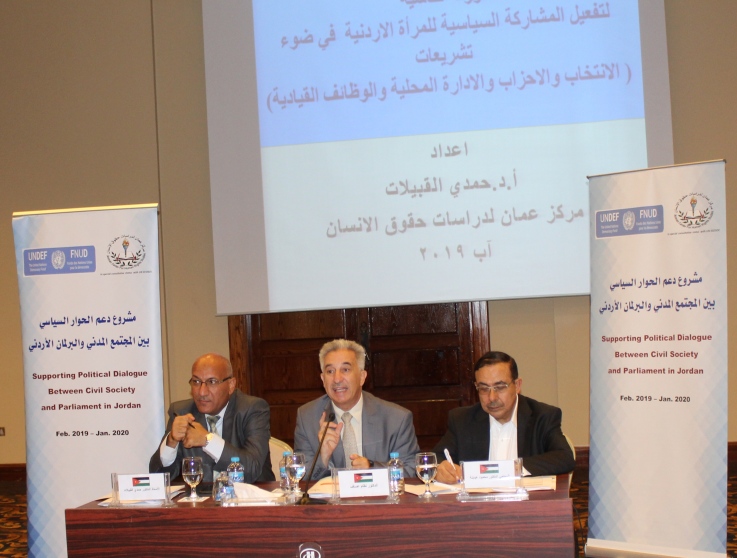
After that, Dr. Mahmoud Ababneh, a former judge and part-time lecturer at the University of Jordan, discussed social and economic rights of women, moreover, women’s rights in personal status law and women’s rights in Jordanian labour law and its amendments.
The first paper highlights different ways to dismantle a traditional and masculine system of gender roles and social norms. This is done, to allow men and women to develop their own abilities to exercise freely their needs and rights, without adhering to conventional social norms. The participants in the discussion emphasised the reality of women’s absence in political participation and public action, including running and being elected for parliament and local councils, women’s access to decision-making positions, being active in political parties and campaigning towards integrating the national women’s agenda into the political programs of parties and candidates. To abolish all forms of discrimination against women in society in order to achieve more egalitarian society and equal access to opportunities. Participants also discussed the reasons behind women’s low participation in political parties, expressing hope to activate Jordanian women to engage in party work, through implementing procedures that enable them to do so.
Gender equality is the embodiment of an equal society amongst all citizens and a foundation for democratic practises, and the presence of women in decision-making positions serves society as a whole. Furthermore, the interlocutors emphasised the importance of the political participation of all citizens, especially the most vulnerable ones.
Second Discussion paper; on women’s social and economic rights
The participants acknowledged that the topic of women’s social and economic rights has evolved over the past twenty years as women’s unions and civil society organizations have criticised legislations on social customs and values that do not see women as equal to men.
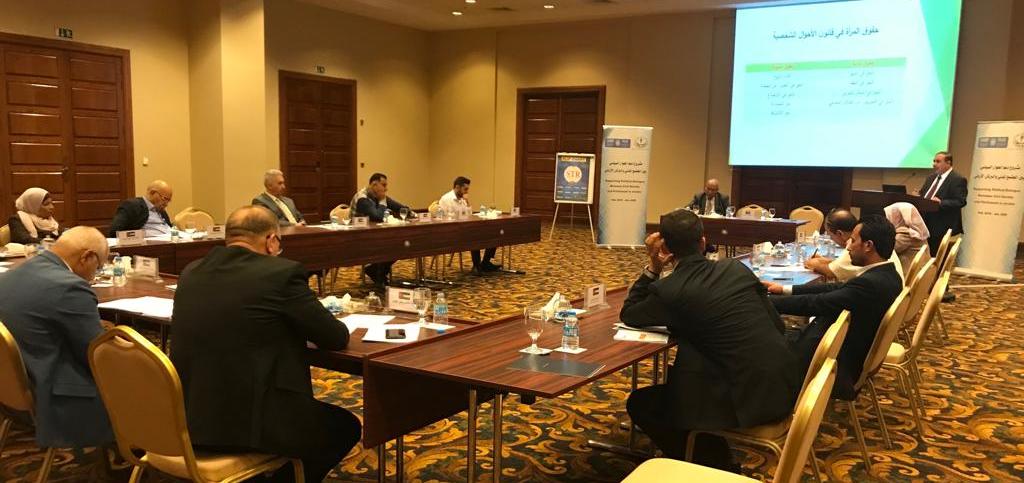
Women’s social and economic rights ensure the possibility to achieve justice and to enable women to benefit from rights participating to their access to the same opportunities as men. Moreover, the recent amendments to the Personal Status Law, Labour Law and the Penal Code have verified and entrenched women’s rights in Jordan. This development can be observed through the implementation of quota mechanism for women in the House of Representatives and in the Council of Ministers. Additionally, the quota system was implemented in the judiciary, the diplomatic corps and at all levels of directorates, departments and public institutions.
Participants commended the new amendments contained in the amended Law No. 14 of 2019, enhancing the protection of women in the work-force through Article 2 of the current Labor Law operative article 128 of the Jordanian Constitution, as well as ILO Convention No. (135) to which Jordan is bound.
After careful and responsible discussions by the interlocutors during the two days of the workshop, 19 recommendations were adopted.
To read the recommendations please click here