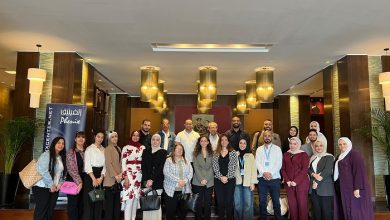
The first session of the political dialogue for members of the Jordanian Parliament

The Amman Center for Human Rights Studies, with the support of the United Nations Fund for Democracy Support, organized the first dialogue seminar in a series of dialogues for the project “Promoting Political Dialogue between Civil Society and the Jordanian Parliament”.
Sixteen members of the House of Representatives participated to discuss the legislation on freedom of opinion and expression, under the patronage of HE Atef Tarawneh, Speaker of the House of Representatives. The event took place on Friday and Saturday, 26 and 27 July 2019 at the Hilton Dead Sea Hotel, where the dialogue was conducted by Dr. Mohammed Al Tarawneh, a member of the Scientific Council of the Center.
The seminar, which was attended by two delegates from the United Nations Head Office in Amman, was initiated by Dr. Nassar al-Qaisi,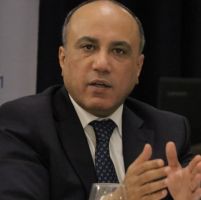 Deputy Speaker of the House of Representatives, who also delivered the speech of the seminar’s sponsor. The speaker welcomed the idea of a social dialogue project, organized by the Amman Center for Human Rights Studies, pointing to the importance of expected outputs that will promote the legislation of human rights. Dr. Al-Qaisi explained the House of Representative’s work during their last session, and the justification of rejecting the last amendments proposed to the latest electronic crime laws, as these amendments carry many elements that are against the basic rights of citizens.
Dr. Al-Qaisi stated that we need today “meaningful Media communications, conveying the truth and moving away from rumors and stopping them at their creation. All of us, in this homeland strive to serve our country, thus we are all in the same position of wanting to defend Jordan, and we all know the nature of the circumstances. We all need to stand behind the leadership of King Abdullah II, and we need to see the priorities to adhere to professional and ethical standards, and to support initiatives and platforms aimed at spreading awareness of the dangers of rumors and false news in all their forms, correcting news that affects the security of society, which plant civil clash and non-progressive and destructive thoughts of darkness.”
Dr. Nizam Assaf, Director of the Amman Center for Human Rights Studies, presented a detailed explanation of the objectives of the project, including the objectives of the four social dialogue sessions with the Parliament, and the future hopes to promote the national legislation related to human rights and raise them to the level of international legislations. He stressed that the Center will direct the final outputs of the social dialogue sessions to all official bodies concerned with the dialogue and to all those interested in social dialogue and all social partners.
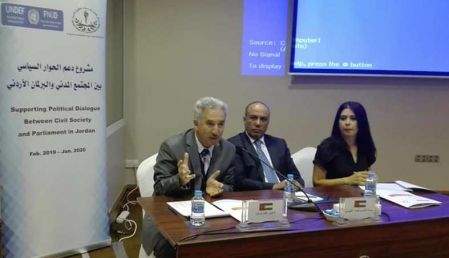
Dr. Assaf pointed out that the dialogue sessions will discuss four issues related to the legislation on freedom of opinion and expression, the right to life, women’s rights and academic freedoms. These sessions will not be limited to political spheres, but will also include dialogues on health care providers, especially civil society. Dr. Assaf stated that the project will involve 100 university students from various universities in these dialogues, as they form the bridge from the present to the future, as the leaders of tomorrow.
Dr. Assaf said that freedom of opinion and expression is at the heart of the aspirations of the Jordanian people. The first session was devoted to the role of social dialogue in the promotion of social and economic progress. Freedom of opinion and expression plays a key role in any attempt to build Democratic institutions as well as more productive, effective, and more equitable and efficient economies.
For their part, the seminar facilitators Dr. Mohammed Al-Tarawneh and Dr. Manal Al-Mazhara presented a comprehensive review of the laws governing the freedom of opinion and expression, and the unique scope of the electronic crimes law for 2015. They gave special attention to the crime law 2015 and its amendments, which were submitted by the government to the House of Representatives, but were rejected by the members, as they did not feel convinced by the justification of the need for these amendments.
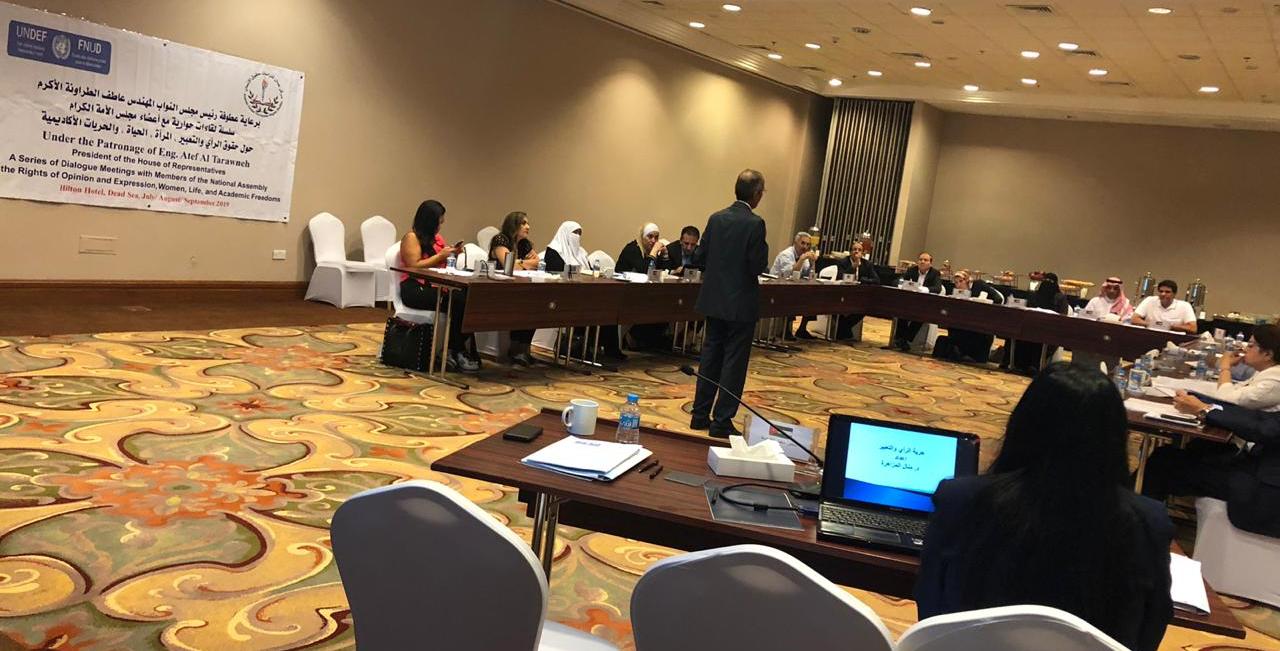
In the details of the dialogue, the deputies and the participants recognized the existence of incorrect use of social media. This justified the important existence of legal controls governing these means, which protects the social peace from interference. The members of the parliament also did not see the solution in the intensification of sanctions, which the government has put forward in amendments.
The deputies pointed out that there are objective reasons that make the Jordanian citizen express his opinion unacceptably and inappropriately. They include, but are not limited to; the weakness of the role of the observer of the House of Representatives, and how to activate the mandate of the authorities and management of the state, where the government plays a major role in the concealment of information, which is not presented in a timely manner. The government pressurizes the members of the parliament, and an example of this is when they send dozens of laws to be amended during one session. The proposal of multiple amendments sees contradictory adjustment passed, with not enough time to discuss and understand them, lessening productivity and creating an overlap in laws.
In order to correct the negative practices of the social media, the deputies stressed the need for the government to publish information on a timely basis, ending its customary practices, to work hard at rebuilding trust between citizens and state institutions by adopting a transparent approach, unifying policies that put everyone under the law, and to stop double standards in dealing with citizens.
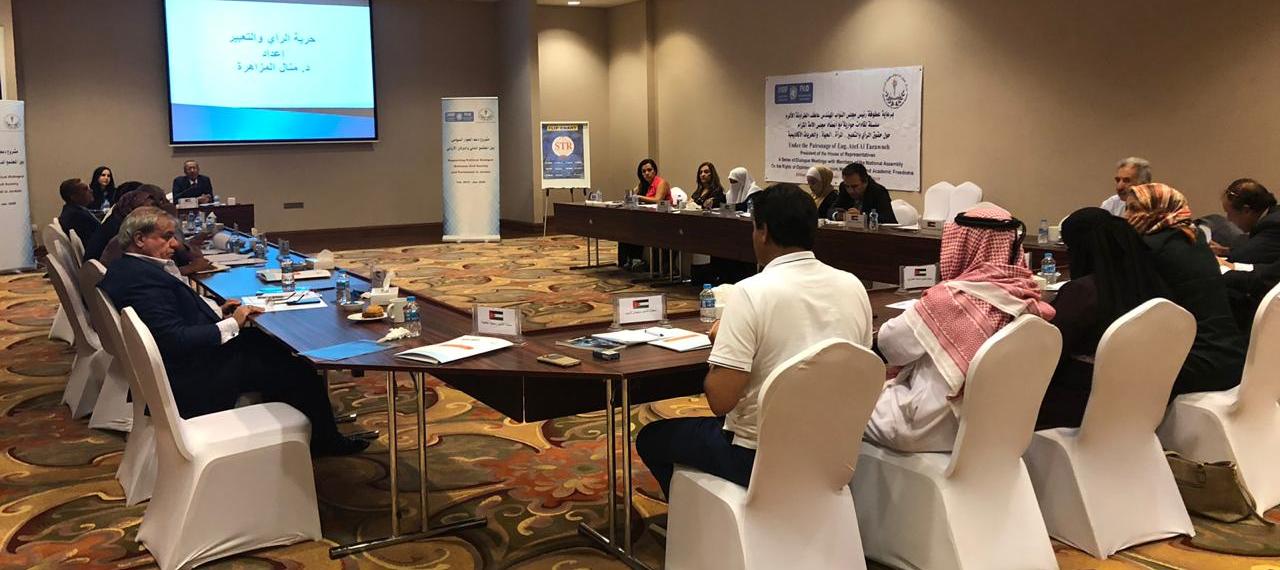
At the conclusion of the symposium, which was dominated by calm dialogue, deep interventions and keen intentions on Jordan’s people and leadership and on the homeland and its security, the deputies and dignitaries participating in the dialogue sessions signed a document of commitment to the recommendations of the dialogue session, and to achieve them within the parliament. The recommendations do not violate the rights of another citizen or exceed the limits set for them; they call for clear and precise definitions and not loose and incomprehensible definitions, as is currently happening, and join unanimously to reject the inclusion of applications of social media law Electronic Crimes Privacy Protection.
The participants in the two-day seminar included: Ibrahim Abu Al-Ezz, Al-Ain Taghreed Hekmat, MP Khalid Ramadan, MP Rasmia Al-Kaabna, MP Randa Al-Sha’ar, MP Sulaiman Al-Zabin, MP Shaha Al-Amarin, MP Sabah The MP, Mr. Sawan al-Sharafat, MP Fadil al-Abadi, MP Mahasin al-Sharaa, MP Mustafa Yaghi, MP Mansour Murad, MP Nassar al-Qaisi, MP Huda Al-Atoum, MP Wafaa Bani Mustafa.