Global State of Democracy: A Look at the Arab World
Prepared by Victoria Rebok
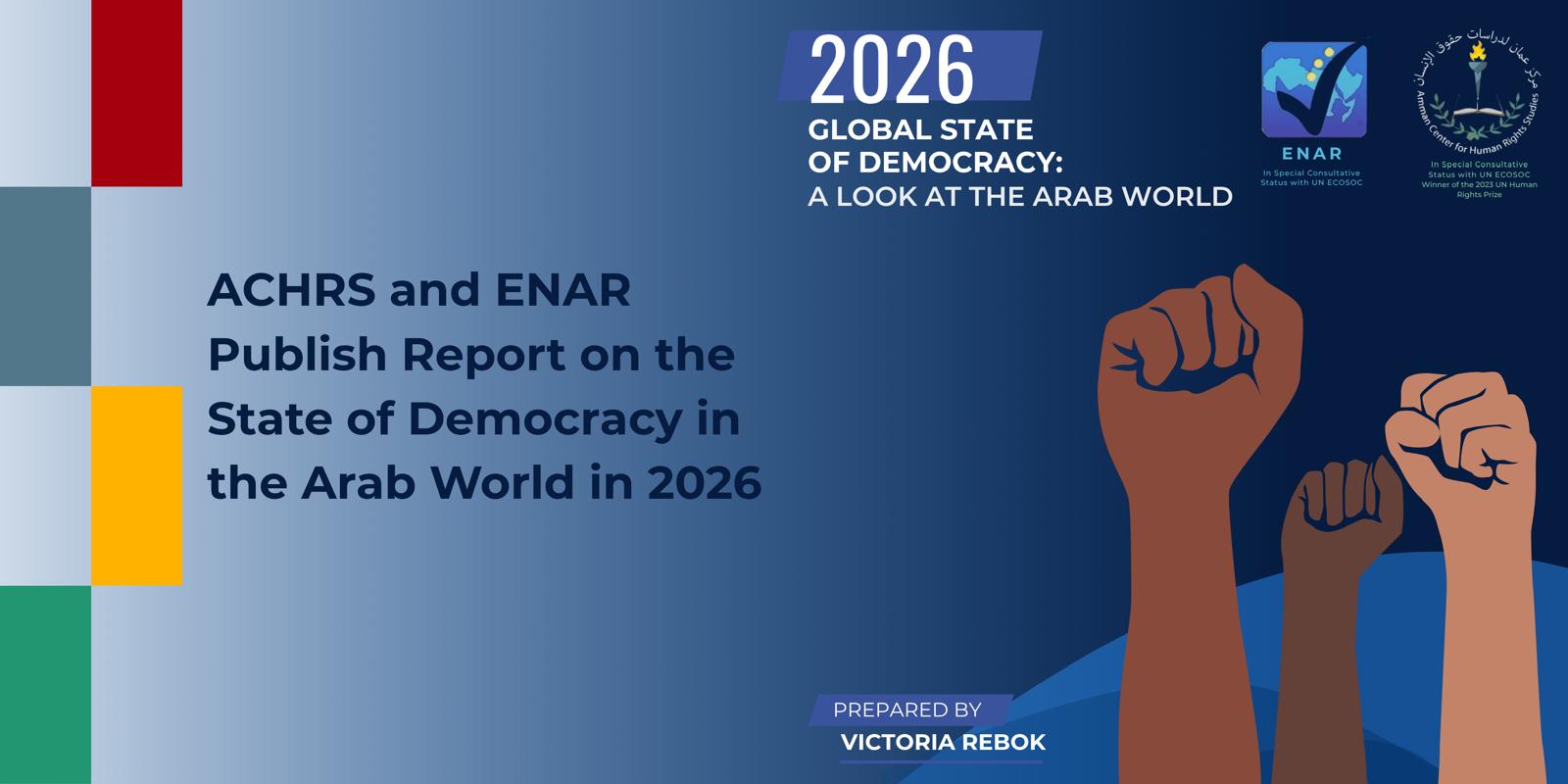
The Amman Center for Human Rights Studies has published its report on the state of democracy in the Arab world, prepared by Victoria Rebok, for the Amman Center for Human Rights Studies (ACHRS).
To read the full report, click here
Democracy in the Arab World: Stagnation, Setbacks and Priorities for Reform
Democratic progress across the Arab world remains limited and uneven, with persistent weaknesses in political representation, fundamental freedoms and public accountability. These are central findings of “Global State of Democracy 2026: A Look at the Arab World”, for the ACHRS, in conjunction with the Election Network in the Arab Region (ENAR).
Drawing on International IDEA’s Global State of Democracy Indices, the report examines democratic developments across the 22 Arab League member states between 2006 and 2025. It assesses four dimensions—Representation, Rights, Rule of Law and Participation—and explores differences across the Maghreb, the Nile Valley and Horn of Africa, the Mashreq and the Gulf.
In 2025, the Arab world’s average scores remained below global averages across all four dimensions. Representation was the weakest, scoring 0.22 compared with a global average of 0.50 on a scale from zero to one. Local Democracy recorded a particularly low regional score of 0.15, highlighting citizens’ limited opportunities to influence decisions affecting their communities. The report stresses that prolonged stagnation at low levels of democratic performance can entrench exclusion and weak accountability.
The analysis also identifies a gap between civic engagement and electoral participation. Citizens’ involvement in community initiatives and civil society does not consistently translate into participation in elections or influence over representative institutions. Meanwhile, improvements in basic welfare have not been matched by equivalent advances in political equality, demonstrating that better access to essential services does not automatically produce more inclusive governance.
The political openings associated with the 2011 Arab uprisings did not develop into sustained regional democratic progress. Tunisia and Libya experienced substantial reversals in several dimensions after their initial gains. In Sudan, improvements following the 2019 transition were undermined by subsequent instability and conflict, while Somalia recorded gains in rights and the rule of law from a low starting point.
Other trajectories underline the region’s diversity. The Mashreq combines relatively stable performance in Jordan and Iraq with deterioration in Lebanon and Palestine and recent improvements in several Syrian indicators. Across much of the Gulf, comparatively stronger welfare provision and performance in some institutional measures coexist with severely restricted political representation.
Responding to these findings, the report identifies five priorities:
– Strengthen elected local councils, municipal autonomy and meaningful political representation.
– Connect civic engagement with credible, accessible elections and continuing public accountability.
– Support an inclusive, Syrian-led political transition, with safeguards for fundamental freedoms, transitional justice and constraints on executive power.
– Consolidate welfare gains while addressing inequalities in resources, opportunities and political influence.
– Tailor democratic reform to each country’s circumstances, recognising differences within and between sub-regions.
Finally, the report calls on governments, civil society and international partners to support institutions that protect rights, enable meaningful participation and sustain democratic gains over time.