Freedom of Religion in Egypt: ACHRS Attends Side Event During the 63rd Session of the Human Rights Council
By Victoria Rebok
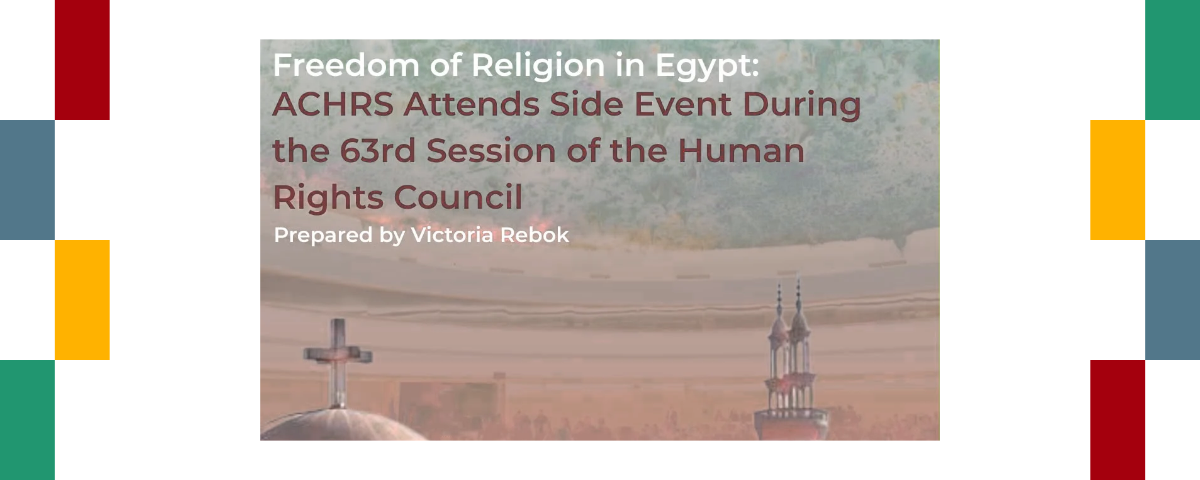
On 16 September, the Amman Center for Human Rights Studies (ACHRS), represented by Victoria Rebok, attended Freedom of Religion or Belief in Egypt. This high-level side event held on the margins of the 63rd session of the UN Human Rights Council was organised by the Bahá’í International Community, Amnesty International, and the Egyptian Initiative for Personal Rights (EIPR).
The event marked the launch of the ‘Erasure: Egypt’s Systemic Campaign to Eradicate its Baha’i Community’ report prepared by the EIPR. Introducing the report, Executive Director of the EIPR, Mr. Hossam Bahgat, emphasised the dire human rights situation in Egypt. In what he characterises as a paradoxical development, freedom of religion has been among the rights to come under increasing threat since 2013. Despite presenting itself as a force against Islamist extremism, President Abdel Fattah el-Sisi’s government has presided over what has been described as the most repressive period for religious freedom in Egypt’s recent history.
Worst affected are those belonging to religious communities not recognised by the State, which remain limited to Islam, Christianity, and Judaism. While individuals outside these recognised religious communities were historically denied any formal recognition by the State, a landmark 2009 ruling by the Supreme Administrative Court affirmed the right of members of other religious groups to obtain identification documents without being compelled to convert. However, as Mr. Bahgat emphasised, the subsequent practice of permitting a dash (–) to be entered in the religion field has itself become a basis for discrimination. Individuals whose identification documents bear a dash are routinely denied access to employment, healthcare and education. The Baha’i community is amongst the worst affected, with bureaucratic hurdles making their lives a struggle “from birth until death”. In a pre-recorded statement, Member of the European Parliament (MEP), Mr. Nikos Papandreou, expressed particular concern at the Egyptian government’s refusal to allow the construction of more burial grounds for the Baha’i, emphasising that the community’s struggles continue “even in death”.
Yet, as highlighted by Mr. Bahgat, while individuals belonging to unrecognised religious groups face the most severe challenges, members of Abrahamic faiths are not immune from prosecution. Those expressing ‘unorthodox’ views may be prosecuted under provisions relating to ‘contempt of religion’, with individuals reportedly subjected to interrogation sessions in which their religious knowledge and beliefs are scrutinised. Questions such as ‘How do you view the Prophet?’ or ‘Are you able to recite this specific surah?’ illustrate what the report identifies as an attempt by the State to reclaim authority over religious belief and ‘purify’ it of perceived impurities.
Professor Nicolas Levrat, Special Rapporteur on Minority Issues, traces the concerning situation of freedom of religion in Egypt to its constitution, which establishes Islam as the State religion (Article 2). Regardless of Article 64’s provision that “freedom of belief is absolute”, the very existence of a State religion means that all others are discriminated against by default. As was aptly surmised by Professor Levrat, this means that regulation which may on its surface appear neutral likely has discriminatory effects. As highlighted by Professor Nazila Ghanea, Special Rapporteur on Freedom of Religion or Belief, the repression of religious freedom in Egypt is not an isolated phenomenon, but a structural and intersectional one.
Concluding the discussion, Dr. Saba Haddad of the Bahá’í International Community emphasised that freedom of religion extends beyond the ability to observe one’s faith in private; it encompasses the freedom to practise one’s religion openly and without fear. In this context, Dr. Haddad called on the Egyptian authorities to move beyond rhetorical commitments and take concrete steps towards meaningful change.
Recognising freedom of religion or belief as an inextricable component of freedom of expression and a cornerstone of democratic society, ACHRS remains deeply concerned by these developments in Egypt. It looks forward to seeing these concerns addressed in the country’s Second National Human Rights Strategy, which is expected to be published later this year.