ACHRS Participates Virtually in the World Humanitarian Day Commemoration at the Palais des Nations
By Victoria Rebok
ACHRS Participates Virtually in the World Humanitarian Day Commemoration at the Palais des Nations
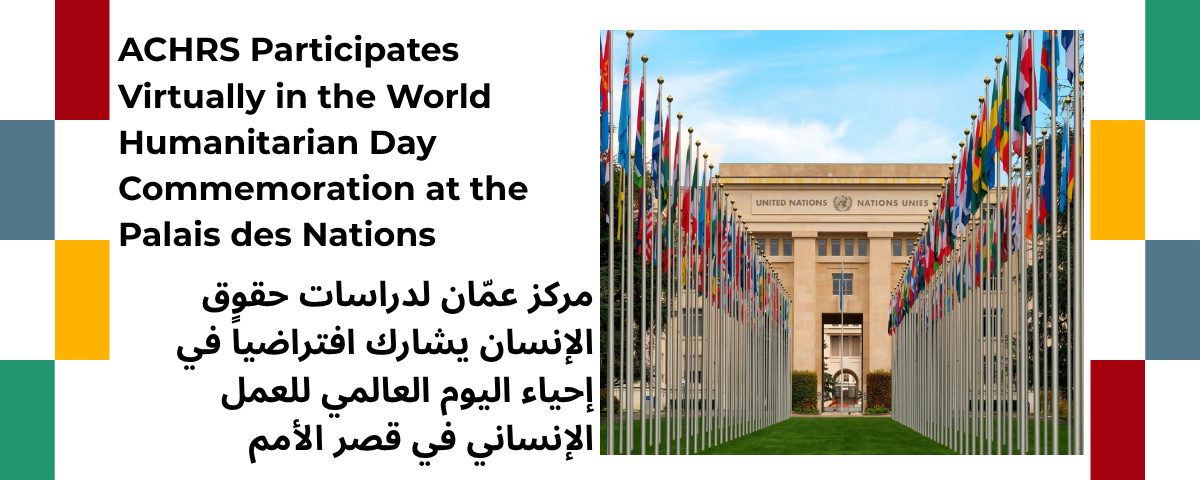
On 19 August 2026, the Amman Center for Human Rights Studies (ACHRS), represented by Victoria Rebok, participated virtually in the commemoration of World Humanitarian Day, held at the Palais des Nations in Geneva.
Ms Alessandra Vellucci, Director of the UN Information Service at Geneva, opened the ceremony with a sobering reminder: 907 humanitarian workers were killed, injured, or kidnapped in 2025 alone. This grim statistic set the tone for the wreath-laying and candle-lighting ceremony, which honoured not only the victims of the 2003 Canal Hotel bombing, but all those who have made the ultimate sacrifice in service of humanity.
Yet, as Ms Tatiana Valovaya, Director-General of the United Nations Office at Geneva, poignantly reminded us, “behind every statistic, there’s a human story”. The importance of recognising this shared humanity was brought into sharp focus by the testimony of Ms Shawbo Taher-Al-Talabani, a former staff member of the UN Office of the High Commissioner for Human Rights (OHCHR) and survivor of the 2003 Canal Hotel bombing. In an emotional and deeply personal account, Ms Al-Talabani vividly recalled the morning leading up to the attack: Mr Sérgio Vieira de Mello, Special Representative of the UN Secretary-General to Iraq, rushing from one meeting to another; colleagues meeting with local Iraqis, in keeping with the mission’s proud open-door policy; and friends sharing photographs of their children. She then recounted the moment the attack struck, the deafening silence that followed, and the agonising wait to learn who had survived and which families would be left to grieve.
While reading the names of the 22 colleagues and friends lost on that fateful day, Ms Al-Talabani emphasised that this must not be yet another list of names to be carved into stone and then forgotten. For memorials to mean something, they must be followed by action.
This was the common thread running through the speeches: the urgent need to translate concern and condemnation into meaningful protection for humanitarian workers. Ms Awa Dabo, Deputy High Commissioner for the OHCHR, warned of a “climate of impunity [that] fuels the violence”. This is all the more troubling given that perpetrators are increasingly State actors– actors who, as Ms Laura Johnson, Executive Secretary of the UNOG Staff Union, underscored, are the bedrock of the international system: bound by its treaties and entrusted with upholding them.
As Ms Gemma Connell, Officer in Charge of the Humanitarian Sector Division at the Office for the Coordination of Humanitarian Affairs (OCHA), succinctly put it, the problem is not a lack of legal frameworks, but a lack of State commitment. The rules exist. They are comprehensive. They have not changed. What has changed is States’ willingness to uphold them.
The targeting of civilians and humanitarian personnel is no longer an unacceptable exception, it is the status quo. A feature of how wars are fought nowadays.
ACHRS echoes UN staff members’ calls for accountability, emphasising that it must be pursued at every level. Failures to protect humanitarian workers must be investigated, those responsible for such failures must be held accountable, and perpetrators of attacks must face justice. Echoing the remarks given by Mr Barham Salih, United Nations High Commissioner for Refugees, ACHRS calls for greater protection for national humanitarian staff, who often face the greatest risk. Above all, ACHRS calls for the international community to #ActForHumanity, recognising that any attack on a humanitarian worker is an attack against our collective humanity.