Human Rights Council: Defining Terrorism to Respect and Protect Human Rights
Written by Tshepo Tlhacoane
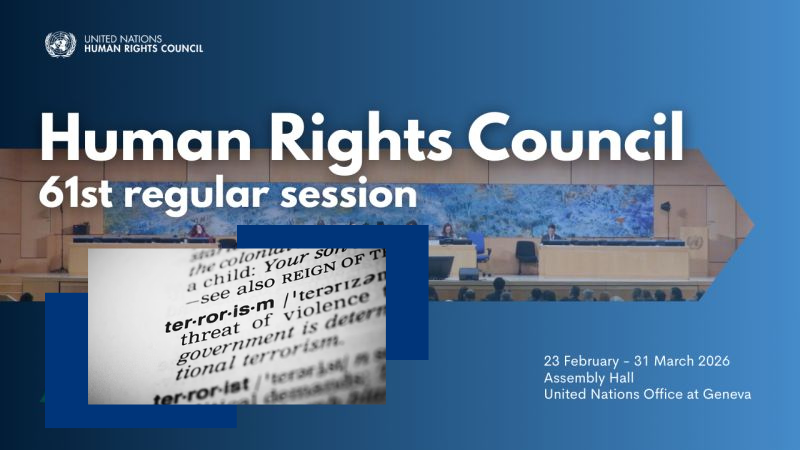
The Human Rights Council convened for its 61st session in Geneva between 23 February and 31 March 2026. Agenda item 3 discussed the report, Defining Terrorism to Respect and Promote Human Rights. The report was submitted by the Special Rapporteur on the Promotion and Protection of Human Rights and Fundamental Freedoms while Countering Terrorism in accordance with Human Rights Council resolution 58/14.
The Amman Center for Human Rights Studies (ACHRS) concerns itself with this report because, regrettably, in the Arab Region, governments rely on anti-terrorism laws to intimidate and jail political opponents and dissidents, as well as human rights advocates and journalists. This directly attacks a number of our priorities, most relevantly the right to speak, which seeks to strengthen the role of journalists and activists in promoting human rights. The lack of an internationally accepted definition of terrorism allows individual states to define it unilaterally, oftentimes in ways that lead to the violation of human rights.
The Need to Define Terrorism
The international community has failed to define terrorism for almost a century, including through a convention on international terrorism. Security Council resolutions have placed an obligation on states to define terrorism, however, states have defined it in a vague and overboard manner which has led to the violation of human rights. Excessive violations, according to the report, can trigger a cascade of violations stemming from criminal offences, police and intelligence powers, terrorist listing of individuals and organizations, financial sanctions, other administrative measures, and immigration laws.
The Special Rapporteur emphasised the fact that vague and overbroad definitions do not satisfy the requirement of legality under article 15 of the International Covenant of Civil and Political Rights, as legality requires offences be accessible and sufficiently precise, with a person knowing the scope of liability in advance. The offence must also be limited to conduct that is genuinely terrorist.
Vague and overboard definitions lead to foreseen and unforeseen consequence, including abuse, which leads to violations of the right to life, liberty, security of person, freedom from torture and other ill treatment, freedom of expression, association and peaceful assembly, participation in public affairs, and non-refoulment. Identified victims of abuse are human rights defenders, journalists, political opponents, minorities, indigenous people, humanitarians, judges, and lawyers.
Although there exist 19 counter-terrorism instruments, they do not sufficiently cover all methods and targets of terrorism. National laws, on the other hand, criminalize most of the physical conduct of terrorist acts, but do not recognize what is distinctly wrongful about terrorism: the instrumental terrorization of the public or the compulsion of governments. An international definition, it is submitted, could provide normative guidance to states to assist them in respecting and protecting human rights.
The report aimed to present a ‘best practice’ international definition of terrorism, which balances the protection of human rights while countering terrorism. It also sought to outline conduct that could not be ordinarily considered terrorist in nature.
Terrorism Definition
The Special Rapporteur, in the report, proposed the following definition:
-
Any person commits a terrorist offence if that person, by any serious criminal act, intentionally causes death, serious bodily injury, or hostage-taking, where:
-
The purpose of the conduct, by its nature or context, is:
-
To provoke a state of terror in the public or a group of persons; or
-
To unduly compel a Government or an international organization to do or to abstain from doing any act;
-
-
The conduct is intended to advance a political or ideological purpose, which must be a substantial purpose; and
-
The conduct, given its nature or context, intentionally causes serious damage to a country or an international organization.
-
-
A terrorist offence does not include:
-
-
An act of advocacy, protest, dissent or industrial action that does not intentionally cause death or serious bodily injury;
-
Conduct committed in armed conflict that does not violate international humanitarian law;
-
The provision of humanitarian activities by impartial humanitarian organizations in accordance with international humanitarian law;
-
The activities of State military forces in the exercise of their official duties, inasmuch as they are in accordance with international law; and
-
An act intended to establish or re-establish democracy, constitutional Government or the rule of law, or to exercise or safeguard human rights.
-
Reflection
ACHRS welcomes this report by the Special Rapporteur, as the abuse of anti-terrorism legislation has been used to intimidate and silence political opponents, dissenting voices, and journalists, among others. Clarification on what constitutes terrorism, and equally as important, what cannot be considered to be terrorism, will prevent the violation of human rights.
ACHRS will continue to monitor proceedings at the Human Rights Council, and report on matters related to our priorities or those related to the Arab Region. ACHRS will provide a more comprehensive analysis of the reports at the conclusion of the 61st session of the Human Rights Council.