Human Rights Council: Impact of Disinformation on the Enjoyment and Realization of Human Rights
Written by Aila Ahmed
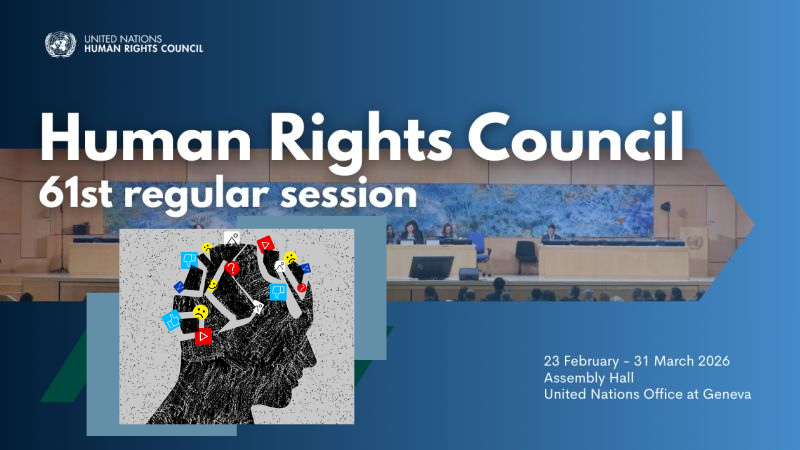
The Human Rights Council convened in Geneva for its 61st session between 23 February and 2 April 2026. Agenda items 3 and 5 addressed the report titled “Impact of Disinformation on the Enjoyment and Realization of Human Rights”, pursuant to Human Rights Council resolution 55/10. This report was prepared by the Human Rights Council Advisory Committee and is based on information from United Nations bodies, States, national human rights institutions, United Nations entities, intergovernmental organizations, civil society organizations and academics.
The report discusses how the swift expansion of digital technologies and social media platforms has significantly transformed the global information environment. However, this has simultaneously enabled the rapid, large-scale dissemination of disinformation. Disinformation, defined as false information purposefully spread to cause serious harm, can be used to manipulate public discourse, hinder the free flow of ideas and accurate information, target minorities and threaten or silence voices. This has the effect of undermining and corroding democracy, media pluralism, human agency, the freedoms of information and expression and the broader enjoyment of numerous other human rights.
Disinformation in the International Human Rights Framework
Disinformation has been recognized as a profound impediment to the exercise and enjoyment of human rights. The report highlights that disinformation may be disseminated by both State and non-State actors, including corporations, politicians, institutions and individuals. Structural factors such as political polarization, declining trust in traditional media and limited media literacy may facilitate its spread, alongside economic factors such as social media companies’ thirst for profit and legal factors including weak rule of law, poor regulation, impunity and a lack of accountability, transparency and human rights due diligence on the part of digital platforms.
In this way, States have a responsibility to address and combat disinformation, and responses must remain consistent with international human rights law and avoid censorship or disproportionate restrictions on freedom of expression (for instance, internet shutdowns or the blocking of websites and media outlets). Addressing disinformation therefore requires cooperation between governments, civil society, media organizations, technology companies and users.
The report highlights several United Nations initiatives aimed at addressing disinformation in the digital environment. Within the framework of the Global Digital Compact, Member States promote the concept of information integrity as a means of countering disinformation to protect human rights and support the achievement of the Sustainable Development Goals. The Compact identifies key methods to strengthen information integrity, including fostering societal trust and resilience, supporting independent and pluralistic media, ensuring transparency and accountability and promoting media and information literacy to enable individuals to critically evaluate information and resist disinformation.
The Role of Technology and Artificial Intelligence
The report notes that technology companies have responsibilities under the United Nations Guiding Principles on Business and Human Rights to prevent and address human rights abuses associated with their platforms, while States have a duty to regulate digital activities and ensure accountability through effective policies and legislation. However, the report highlights that responses by both States and businesses to these challenges have often been slow and inadequate.
The report also highlights the growing role of AI-generated content, including deepfakes, which has made disinformation increasingly difficult to detect and may influence how users interpret and engage with information. Artificial intelligence can also automate the creation and dissemination of disinformation campaigns, enabling malicious actors to spread false information rapidly and at scale. At the same time, technological tools may assist in identifying coordinated disinformation campaigns and manipulated media, including bot networks and altered images or videos.
Impact of Disinformation on Human Rights
The report identifies several human rights that are directly affected by the spread of disinformation.
Freedom of expression and freedom of information
Disinformation undermines freedom of expression and access to information, protected under Article 19 of the Universal Declaration of Human Rights and the International Covenant on Civil and Political Rights. Disinformation can dominate the public information space and silence voices. This weakens the ability to assess information freely, form informed opinions, participate meaningfully in democratic processes, clearly undermining the rights to information, expression and participation. The report also notes that content moderation often fails to adequately address disinformation in non-English languages; speakers of other languages, particularly in the global South, often remain insufficiently protected.
Right to privacy and protection of reputation
The report notes that disinformation can undermine the right to privacy and protection of reputation, as recognized in Article 12 of the Universal Declaration of Human Rights. Disinformation campaigns often utilize personal data to microtarget individuals with tailored false content, threatening the rights to privacy and consent. This viral spread of false information can significantly damage individuals’ reputations, thereby limiting their right to freedom from unlawful attacks upon one’s honor and reputation.
The report thus highlights the importance of robust data protection frameworks and greater transparency in the collection and use of personal data, noting that even large-scale surveillance justified as combating disinformation infringes upon privacy rights.
Right to health and access to scientific knowledge
The report notes that disinformation may undermine the right to benefit from scientific progress, guaranteed under Article 15(1)(b) of the International Covenant on Economic, Social and Cultural Rights. The distortion and falsification of scientific information can limit scientists’ freedom of expression, hamper informed decision-making and affect the enjoyment of other rights, including the rights to health, education and food. The report also emphasizes the importance of ensuring independent media and public access to reliable, verified scientific information.
Right to participate in public affairs
Disinformation also undermines democratic participation and the right to vote by distorting electoral processes and results, thus making it more difficult for individuals to make informed decisions about political processes and candidates.
Groups Particularly Affected by Disinformation
Women
The report notes that disinformation targeting women often exploits gender stereotypes and misogynistic narratives, using abusive or sexualized content to silence women’s voices, which blatantly undermines their right to freedom of expression and right to participate. Women in public positions, including journalists and politicians, are frequently targeted by coordinated online abuse and disinformation campaigns that combine misinformation, hate speech and threats, which discourages their participation in democratic processes and public discourse and delegitimizes their roles and involvement in governance.
Minorities and marginalized communities
The report notes that disinformation disproportionately affects historically marginalized groups, including racial, ethnic and religious minorities, Indigenous Peoples and other socially excluded communities. False narratives and disinformation often distort historical narratives, reinforce stereotypes, spread falsehoods and incite discrimination, deepening existing inequalities and hierarchies and diminishing political participation among affected communities.
The report also highlights that disinformation may amplify prejudice and social division by dehumanizing or criminalising minority groups as threats or scapegoats, leading to the justification of marginalization and repressive or exclusionary policies. For instance, disinformation targeting individuals based on sexual orientation and gender identity has further contributed to the marginalization of LGBTQIA+ communities.
Migrants and refugees
Disinformation frequently portrays migrants and refugees as economic burdens or security threats, undermining social cohesion and distorting public perceptions of migration. This anti-migrant rhetoric and imagery, fuelled by false claims about crime, welfare burdens or cultural threats, can fuel xenophobia, violence and influence restrictive migration policies such as arbitrary detention, family separation and pushbacks at borders, all of which devalue migrant rights and violate international human rights standards.
Journalists and media workers
The report notes that disinformation poses a serious threat to journalists and media workers, undermining press freedom, media pluralism and public trust in independent media. Journalists who expose disinformation or investigate corruption and human rights abuses are increasingly targeted by smear campaigns, false narratives and coordinated harassment intended to discredit and silence them, limiting their human right to freedom of expression and the right of the public to access accurate information.
The report also highlights that female journalists are particularly vulnerable to online abuse and disinformation campaigns, often involving gendered harassment and the manipulation of personal information. In addition, environmental journalists have faced growing physical and online attacks in recent years. The report emphasizes that measures to combat disinformation must respect the principles of legality, necessity and proportionality and should not be used to censor or silence journalists.
Human rights defenders
Human rights defenders are also frequent targets of disinformation campaigns that attempt to portray them as foreign agents or political agitators. These narratives can create hostile environments that restrict their right to freedom of speech and civic space.
Children
The report notes that children are particularly vulnerable to disinformation due to their limited capacity to assess the reliability of information, highlighting that children with disabilities and those in conflict settings may face greater risks.
Disinformation in context
Disinformation campaigns may spread false narratives aimed at discrediting and delegitimizing international human rights institutions, United Nations bodies and human rights organizations, often portraying them as biased, corrupt or agents of foreign influence. Such narratives can distort public understanding of human rights and international law, meaning human rights violations are more likely to occur or go unchallenged.
Furthermore, in conflict zones, disinformation may be used by State actors and authoritarian regimes to delegitimize human rights organizations or international courts and divert attention from alleged abuses. The report highlights that disinformation has become an increasingly significant element of hybrid warfare; fake news may be used to justify conflict, shift responsibility, suppress voices and dehumanize opposing groups or populations, and digital technology has made it easier to interfere in conflicts from across borders. False or misleading information also may create panic, cause civilian danger and undermine humanitarian operations.
Democracy, social cohesion and elections
The report notes that disinformation poses a serious threat to democratic processes, like elections, by manipulating public opinion, eroding trust in institutions and distorting political decision-making. Disinformation campaigns may spread false claims about electoral procedures, defame candidates and delegitimize election results.
Emerging technologies, including artificial intelligence and deepfakes, have increased the scale and sophistication of disinformation. Microtargeted political advertising may further distort political discourse. The report notes that politicians, as well as social and religious leaders, have significant influence over public discourse and therefore bear particular responsibility in preventing the spread of disinformation.
Disinformation and science
The report highlights that disinformation undermines public trust in science by spreading misleading narratives and conspiracy theories as legitimate alternatives to scientific consensus, undermining people’s ability to distinguish between reliable and unreliable sources. Moreover, disinformation can distort complex scientific findings to create doubt, confusion and mistrust in science.
Environmental disinformation
The report notes that environmental disinformation has been used to undermine public understanding of environmental issues and delay action on climate change. Certain corporate actors and organizations have supported campaigns that question scientific consensus, promote misleading narratives or exaggerate environmental commitments through practices such as greenwashing. Such disinformation can weaken environmental policymaking, erode trust in climate science and undermine the protection of human rights, including the rights to health, food, water and a clean, healthy and sustainable environment.
Disinformation and public health
The report notes that disinformation poses significant risks to public health by spreading false information that undermines trust in health institutions and obstructs effective responses to health crises. During the COVID-19 pandemic, misleading narratives about the virus and its treatment made it difficult for people to find trustworthy guidance, which contributed to confusion and vaccine hesitancy. This deepens health disparities by disproportionately affecting vulnerable populations with limited access to reliable healthcare and digital connectivity.
Systemic forms of disinformation
The report notes that disinformation can also be systemic, marginalizing vulnerable communities, distorting public understanding and perpetuating racism and social inequalities. Sustained disinformation campaigns have contributed to stigmatization and misinformation in contexts such as the HIV/AIDS epidemic and the persistence of racial discrimination.
Reflection
The Amman Center for Human Rights Studies (ACHRS) welcomes the report presented to the Human Rights Council on the impact of disinformation on the enjoyment and realization of human rights. The report offers an important contribution to understanding how disinformation can weaken democratic processes, erode public trust and threaten the protection of fundamental human rights.
ACHRS supports the report’s emphasis on tackling disinformation through a human rights-based approach that strengthens access to reliable information, protects freedom of expression and reinforces societal resilience. In this regard, ACHRS welcomes the recommendations that States should ensure their responses to disinformation remain consistent with international human rights law. ACHRS further encourages governments to strengthen protections for journalists and independent media, expand media literacy, better regulate online platforms and ensure access to reliable public information. ACHRS also emphasizes the importance of stronger accountability for digital platforms and technology companies, including human rights due diligence, greater transparency in algorithmic systems and safeguards against the misuse of artificial intelligence and deepfake technologies.
ACHRS will continue to monitor discussions in the coming weeks, and will provide a more comprehensive analysis of the reports at the conclusion of the Human Rights Council.