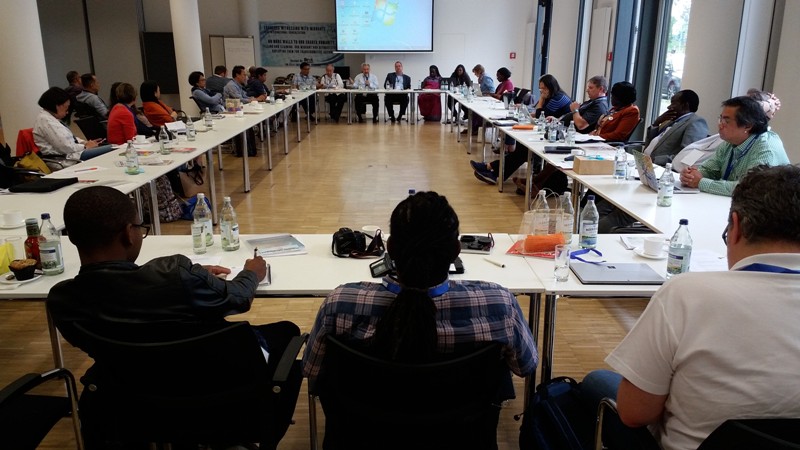
In late June, ACHRS director Dr Nizam Assaf was invited to speak at the 8th International Consultation of Churches Witnessing With Migrants (CWWM8) in Berlin, Germany. With delegates from over 48 participants from 29 country from all over the world, this event produced “Berlin Talking and Doing Points” which is issued for the 10th Global Forum on Migration and Development where the theme was “Towards a Global Social Contract on Migration and Development”.
The focus of CWWM8 was the reflection of the struggles facing migrants and refugees travelling to Europe: the struggle for recognition, the struggle for security, the struggle for survival. As well as an examination of policies and practices within the EU regarding migration, this Consultation involved a discussion of the myths surrounding migration and the real-life experiences and lessons learned in local communities in Europe that had accepted and supported migrants and refugees.
Dr Assaf addressed the CWWM8 with a presentation about the links between humanitarian aid and religious extremism within refugee communities. Dr Assaf thanked the international aid community for the emergency shelter, food, health services and countless other services provided to refugees communities. However, he also highlighted that one area that lacked attention was culture.
Refugees living in neighbouring countries in the Middle East are a vulnerable population: vulnerable to poverty, vulnerable to discrimination but also vulnerable to the influence of Islamic fundamentalism and extremism. Much of the refugee population living in camps in the MENA region have faced extraordinary circumstances and human suffering; because they are angry and in despair they are receptive to fundamentalist ideas that feed off these emotions, even for the most open-minded and educated refugees.
In the absence of efforts by the international community to educate refugees about culture and responsible civic life, this gap is being filled by Islamic aid organisations pushing a fundamentalist view of Islam both within and outside of refugee camps in the Middle East and via online platforms.
Aid is rarely completely apolitical, and with its goods and services, those that provide aid are in a position of power and influence within the refugee communities: when those who wield this influence push violent and fundamentalist ideas of Islam, it is extremely problematic.
Dr Assaf appealed to those gathered that it is the international community’s duty to prevent these ideologies gaining traction with vulnerable people, like refugees, by educating them about the importance of culture and responsible civic life. These programs would provide an education about democracy, human rights, peaceful resolution of conflict and other sustainable practices as well as training refugees to have the skills to respond to their situations in a non-violent way and maintain hope for the future.
Dr Assaf’s final words to the CWWM8 stressed the importance of ending the cycle of violence and extremism that exists within refugee and migrant communities, intensified by the influence of Islamic fundamentalist aid. He reiterated the importance of filling the gap for civic education so that the terrible consequences of war and oppression are not perpetuated through fundamentalist and extremist thinking and hate, but rather, are combatted through teachings of human rights, conflict resolution and responsible civic duty.
In a final statement outlining the major talking points coming out of CWWM8, the main outcomes of the talks were the importance of upholding inherit human rights and human dignity by stopping human trafficking and smuggling involved in forced migration. In doing this, it must be reiterated that forced migration is a human tragedy involving human suffering and trauma. As such, a sustainable solution must be found with the involvement of migrants and refugees in all platforms of dialogue and development of this solution. To read the closing statement in full, please click here.