Jordanian Alliance calls for the abolition of the death penalty and pays tribute to the formation of a parliamentary alliance against the death penalty

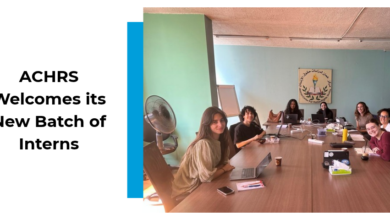
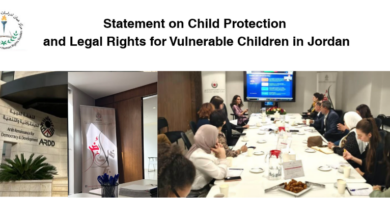
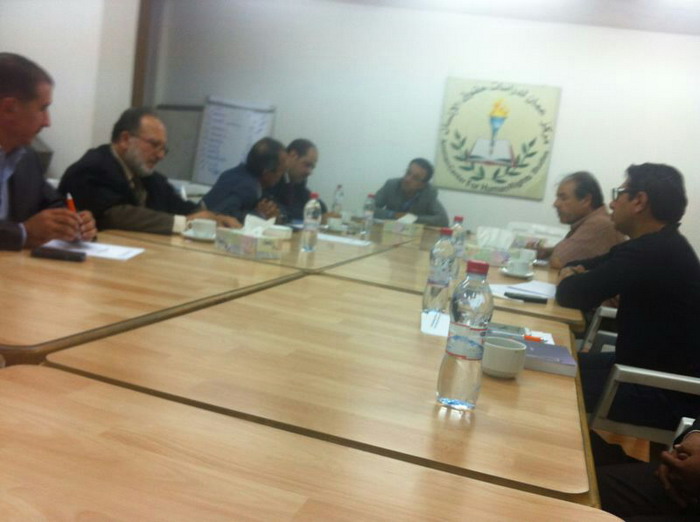
On the 11th anniversary of the World Day Against the Death Penalty, which falls on 10/10 of each year, the Executive Committee of the Alliance of Jordan against the death penalty held on Saturday, October 5th, a meeting in Amman Center for Human Rights
Studies headed by MP Dr. Mustafa Yaghi, head of the Legal Committee in the House of Representatives of Jordan, and was attended by MP Dr. Hazem Qashoo, Dr. Mohammed Al-Tarawneh, President of Arab Coalition against the Death Penalty, His Eminence Sheikh Dr. Hamdi Murad, Hussam Al Bahou, for Amnesty International Group in Jordan, Ramzya Khatib, from the Association for Arab Women, Issa Marazeeq, human rights activist, Raed Al-Athamneh human rights activist, and Salem Qbilat, secretary of the Alliance of Jordanian Journalist, and the meeting discussed the local efforts and international movement to stop the application of the death penalty .
The meeting appreciated forming the nucleus of a coalition against the death penalty in the Jordanian House of Representatives comprising (23) MPs, and considered it an advanced civilized step to enhance local efforts that are being made at this level, and elevate Jordan to a new distinct status among the countries that have taken effective measures to reduce the death penalty.
The Meeting praised the Jordanian official efforts calling on the international society to abolish this sentence, appreciating its commitment to the protection of the principle of the right to life, for despite the past and present difficult circumstances in Jordan, no political prisoners were sentenced to death, no execution was ratified since 2006, and the Jordanian legislator limited the death penalty crimes to the most serious and highly criminal, and so no arbitrary death sentence was executed, and it often deferred judgment in order to open the way for reconciliation between the offender and the victim, made way also for self-correction, considering that it brings more important benefit than the death penalty.
MP Mustafa Yaghi called to initiating deep dialogue on the idea of abolishing the death penalty, which began years ago as a strange idea, like any other new ideas, but today it receives great understanding by the majority of national human rights institutions, which requires greater interaction and dialogue to convince the general public of the rightness of this idea through intensifying awareness effort and dialogue seminars supported the enlightened clergy.
Yaghi also pointed to the need to strengthen cooperation between the coalitions against the death penalty, the Jordanian House of Representatives, and the Arab parliaments to arrive at a legislation to limit the death penalty.
MP Hazem Qashoo praised this effort that needs a broader unite, alluding to the importance of starting the initiative by a number of MPs for the establishment of a coalition opposing the death penalty, which highlighted the global civilized face of the Jordanian people .
Qashoo demanded not to stop by the step of 2006 under which the implementation of the death penalty froze, and pointed out that the House of Representatives, the government, and civil society organizations are partners in this project, and called for the transfer of some activities from Europe to Jordan so that the Jordanian people would know the values that earned from the adoption of these ideas, as it also provides an opportunity and access to international grants.
Qashoo demanded developing a six-months time plan, especially since the Jordanian Alliance enjoys the presence of parliamentarians, judges, clerics, media men, and distinct lawyers in its ranks, in addition to the support of the leader of the country, which allows the formation of a Royal Commission to assign this project, working to present the civilized Jordan to the world, as we also want to be an esteemed model in the region, and he also demanded that one of the proposed seminars be with members of the House of Representatives .
Dr. Mohammed Al – Tarawneh, President of the Arab Coalition Against the Death Penalty, emphasized that the opportunity is now available to reduce some of the articles under which falls the death sentence and are no longer valid for this particular time, especially materials of the Military Penal Code, such as:
– Article (10) – rebellion and disobedience, which are of the materials that are punishable by the death penalty, noting that this text became invalid after the events of the Arab Spring and the change that is happening in the whole world.
– Article (13) disobeying orders during the war – (needs to be reviewed).
– Article (38) assisting the enemy during the war – (needs to be reviewed).
– Article (41) war crimes – inconsistent with the Statute of the International Criminal Court, which is punishable by life imprisonment .
– Article (373) arson .
– Article (381) interrupting transportation.
Dr. Tarawneh demanded preparing a paper to these topics and providing alternative suggestions to the concerned authorities.
Cleric Dr. Hamdi Murad also praised the qualitative effort and work of the Committee in the House of Representatives that shouldered the message of tolerance and do justice, based on the rules of scientific legitimacy on the diligence and legacy of the nation, which had previously led the human civilization to prosperity, and laid the beautiful examples and high human values.
He also noted that Islamic law has preserved human dignity and the right to life and liberty, which is one of the basic purposes of Islamic law, and Islam considered murder as if directed to all humanity, but he also said that there is a real problem in the mechanisms of jurisprudence, as there are those who fault jurisprudence, which led to the emergence of a problem in the case of religious understanding, as bin Laden commits massacres in the name of Islam and under the pretext of Share , and not only this, but he faces a real problem in the lack of coping with global development, which requires us to re-examine the laws and restudy Islamic thought, especially in light of the so-called Arab Spring , which only benefited “Israel” and the Muslim Brotherhood groups .
Dr. Murad pointed out that misconception of Islam had wronged Islam, and the West marketed the idea that Islam is a religion of terrorism, of which it is innocent, but some religious scholars have abused Islam and what they misinterpreted is not Islamic thought or product, noting that mundane laws cannot achieve absolute justice, but relative Justice, and relative justice could err, so the death penalty must be stopped, for the possibility that the decision is wrong, for Islam rejects the death penalty, according to Dr. Murad.
Dr. Murad called upon non-governmental organizations to be supportive of this humanitarian civilized action to shift towards the most serious crimes and reduce the number of articles in the law punishable by death from 26 items to only 3, and wished that the Jordanian Alliance contacts Committee formed in the House of Representatives, and he called for the use of modern means of social communication, like creating a page on (Face book) for the Jordanian Alliance to show the interventions and materials of seminars, and he also called for intensifying awareness raising in universities among students .
Human rights activist, Issa Marazeeq, supported all proposals that preceded and added some of the proposals calling for the importance of expanding activity with civil society organizations, and the need for a specific program of the Alliance that takes full benefits of the media, and concluded by demanding Jordan to sign the Optional Protocol, which inevitably leads to harmonizing local legislation with the UN, and he recommended contacting the National Center for Human Rights to take advantage of the great potentials it has.
Hussam Al Bahou, the activist of International Amnesty in Jordan, reviewed previous experiences where drama was used to raise awareness and attract attention during which focus was on Article (3) of the Universal Declaration of Human Rights (the right to life), and stressed the humanization of laws, i.e. make it more humane, for texts are not static but they are tolerable to interpretation, and it would be easy to condemn a person at the whim and mood of a judge, so it is necessary for the judiciary to maintain its image and credibility in front of the society, the judge is the hand of heavenly justice on Earth, and it is his responsibility that we do not turn from the world of the force of law to the world of the law of force, noting that the death penalty is the only punishment which, if carried out on an innocent, cannot be undone .
In conclusion, the participants called on the government to work on reducing the death penalty as a prelude to abolishing it on the basis of the Jordanian state’s commitment to the UN covenants on Human Rights, and in order to achieve this, we have to start b the n reducing the number of crimes punishable by death.
Amman, October 6th, 2013.