The situation in Syria – Security Council, 10143rd meeting, 22 April
Written by Nina Lesueur
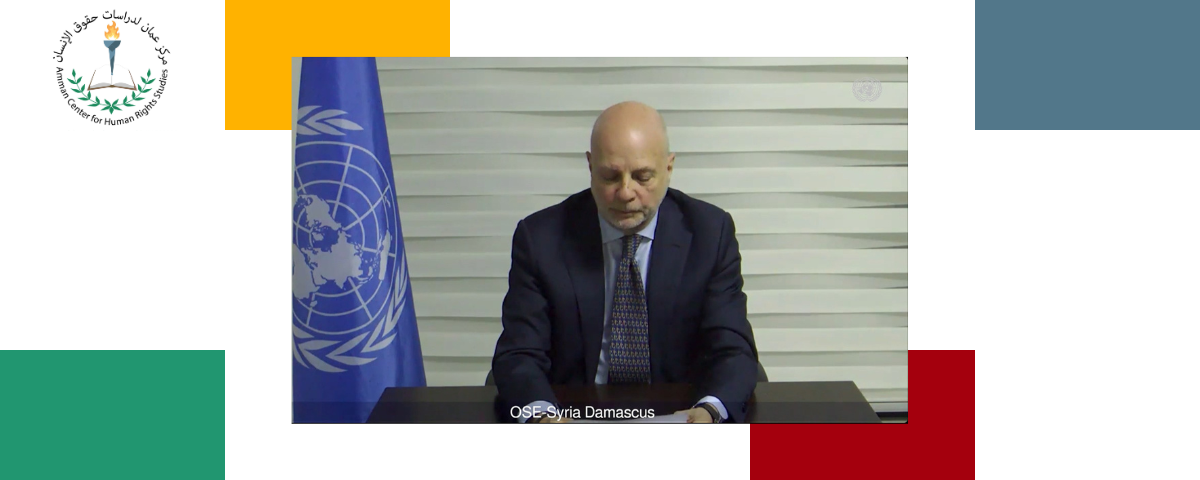
The security council meeting which took place on 22 April was a briefing on the actual political and humanitarian situations in Syria. After the deputy Special Envoy for Syria Claudio Cordone and Under-Secretary-General for Humanitarian Affairs Tom Fletcher did a briefing on political and humanitarian developments, the Special Representative of the Secretary-General for Children and Armed Conflict Vanessa Frazier debriefed on her mid-February visit to the country. Then, the representatives of the different countries intervened to express their main concerns about the current situation in Syria.
This meeting allowed us to understand clearly the main UN’s preoccupation with guaranteeing Syria’s stabilization and its actual development post Bachar Al-Assad’s regime.
Even though there has been progress in stabilizing and insulating Syria from multiple regional crises, significant challenges to the country’s political transition remain. Despite repeated violations of Syria’s sovereignty, economic and institutional pressures, along with localized insecurity, continue to pose major obstacles. Various external factors also threaten Syria’s current stability.
First of all, Israeli military activities continue to violate Syria’s sovereignty and territorial integrity, notably through ongoing military operations in southern Syria, despite existing agreements and international law. Israel also carried out airstrikes on Syrian military infrastructure on March 19, for the first time since July 2025, and has continued to conduct incursions into Syrian territory, including during an operation against Hezbollah in southern Lebanon on March 29. Israel continues to establish checkpoints and detain Syrian citizens. In addition, on April 22, Israeli citizens crossed the border near the village of Hader before being arrested by the Israeli army.
Several risks can also be identified as threats to the progress made in the country’s stabilization since the fall of Bashar al-Assad in December 2024. Even though Syria is not officially part of the regional conflict, it has placed the country under pressure, particularly due to the influx of 300,000 people who crossed the border from Lebanon. The return of 1.6 million Syrian refugees after the civil war also represents a major challenge in terms of providing adequate support.
Internal challenges remain significant for the country: tens of millions of Syrians need food, water, and healthcare. Furthermore, landmines continue to detonate across the territory, killing more than 50 people since March. The clearance of mines and explosive remnants of war remains a recurring issue of civilian protection. Widespread contamination from explosive remnants of war poses a serious threat to children and is a major cause of child casualties. In 2025, the level of violations against children remained high, exceeding that of the previous year. The forced recruitment of children by armed groups also continues to be a major concern.
The Special Representative of the Secretary-General for Children and Armed Conflict also raised awareness on the deteriorating of the children’s situation about the children’s situation in the Al-Hawl-camp (now close by the government) and the Roj Camp in the northern Syria, included their current life’s conditions and absence of birth registration. She urged the concerned states to facilitate the voluntary repatriation of the concerned children with suspected families tied to ISIS.
Progress was made with the holding of indirect elections for nine vacant seats in the People’s Assembly from three districts in Hasakah governorate. The priority for the forthcoming People’s Assembly will be to review and enact legislation aligned with the aspirations of the Syrian people, including a law on transitional justice, in coordination with the National Commission for Transitional Justice. Transitional justice appears to be an essential mechanism to prevent recurring cycles of violence. The Syrian government is encouraged to cooperate with the independent and impartial UN mechanism for Syria. Progress has also been made in the northeast, particularly following the peace agreement between the Syrian government and the Syrian Democratic Forces, with government deployments, the handover of various sites, and the release of additional detainees.
However, new protests are also emerging because of the economic difficulties, as has been pointed out : On April 17, a pacific protest in Damas calling for better life conditions and political reforms and a counter-protest which ended by escalation of violence and physical injuries. This reminds the situation of the Sweida’s village, where violations of humanitarian and human rights, including murders and abductions, happened several times, including in July 2025, after protests calling for self-determination, the improvement of living conditions and the releasing of the detainees. Localized sectarian and communitarian violences are also a preoccupation, and the Christian community have been protected by the government during Easter celebrations.
The different parties agreed on the necessity to increase the international financial aid to ensure the growth and stabilization of Syria, and also the necessity of insurance between Syria and the United Nations on several topics.