Oral statement for the 62nd Regular Session of the United Nations Human Rights Council
By Filipe Dias Kalgaard
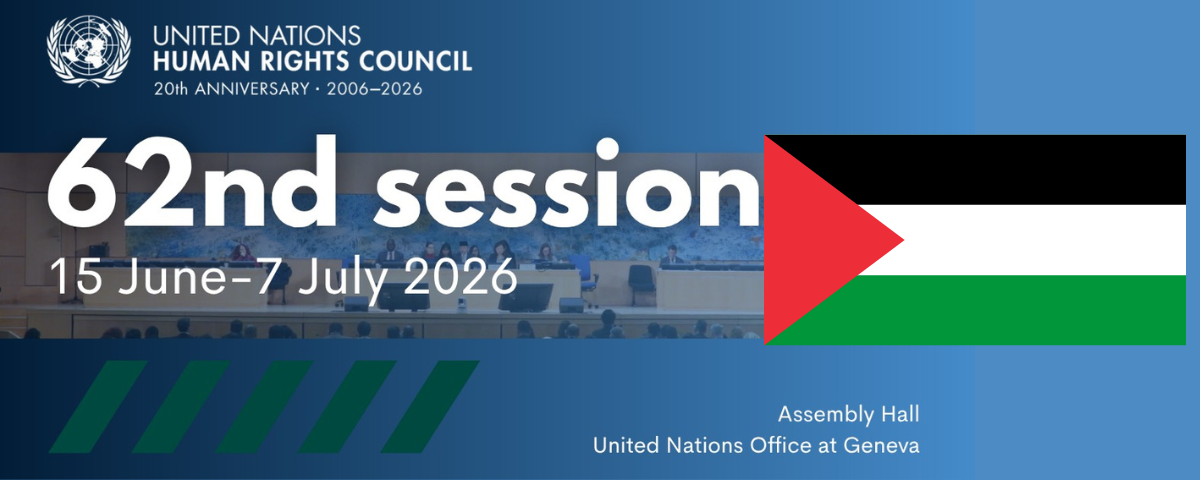
Date: 16th of June 2026
Location: Assembly Hall, Palais des Nations, 14 Avenue de la Paix, Geneva, Switzerland.
Item 2: ID on the report of the Independent International COI on the Occupied Palestinian Territory, including East Jerusalem, and Israel
Mr. President,
The Amman Center for Human Rights Studies welcomes the continued work of the Commission of Inquiry.
The situation in the Occupied Palestinian Territory, including East Jerusalem, and in Israel is not a new, nor isolated crisis. It is a state of emergency and occupation that has been ongoing for nearly eight decades. Its severe effects are felt across the Middle East, where daily lives of families, refugees, and society as a whole are disrupted by war, displacement, and genocide.
We call on all parties to comply fully with international human rights law. Civilians must never be targeted. Humanitarian access must be immediate and comprehensive. Palestinians live with the risk of kidnapping, arbitrary detention, torture, collective punishment, and attacks on journalists, medical workers and human rights defenders – these atrocities must end. Palestinians continue to suffer the effects of occupation; which are systematic discrimination, dehumanisation, and silencing of Palestinians under false pretexts of security. A recent example of such impunity by the occupation forces is the 2026 death penalty law. Every Palestinian that is killed, silenced or discriminated, is another voice, another ordinary person, and another future lost.
Therefore, accountability is a necessity. The Council should support independent investigations, preservation of evidence, and full cooperation with United Nations mechanisms, including this Commission. We urge States in the region to protect the civic space. Peaceful expression, documentation, advocacy, academic freedom and solidarity must never be criminalised.
The Amman Center for Human Rights Studies calls for a rights-based regional response that ensures 1) protection for civilians, 2) justice for victims, 3) humanitarian access, and 4) renewed commitment to equality, dignity and the rule of law.
Thank you.
Read as PDF here