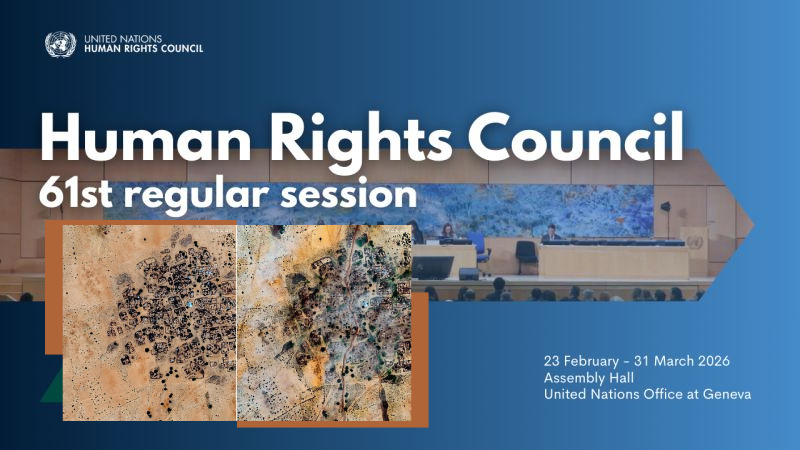
The Human Rights Council convened in Geneva for its 61st session between 23 February and 31 March 2026. Agenda item 2 dealt with the report, Sudan: Hallmarks of Genocide in El-Fasher, based on an independent international fact-finding Mission, pursuant to resolution S-38/1. The resolution requested an urgent inquiry into reported violations on international human rights law and international humanitarian law committed around El-Fasher, and to identify whether there was prima facie evidence that conduct during hostilities rose to the crime of genocide.
The fact-finding Mission interviewed 320 witnesses and victims from El-Fasher and surrounding areas. The Mission also consulted with 28 survivors, and also went to Chad and South Sudan where it interviewed additional survivors from the El-Fasher area. The fact-finding Mission also collected non-testimonial evidence and information, including around 40 reports and related materials, it verified and corroborated 25 videos, and held over 37 meetings with civil society organizations, human rights defenders, and other experts.
The independent fact-finding Mission did not receive cooperation from Sudan, nor did they receive cooperation from the Rapid Support Forces, despite assertions that they would cooperate with the Mission.
This report will limit its scope to whether there is prima facie evidence of genocide in El-Fasher. For a comprehensive report on the human rights situation in Sudan, click here.
Legal Framework
The Mission confirmed that the ongoing conflict between the Rapid Support Forces and the Sudanese Armed Forces meets the threshold of a non-international armed conflict, to which Common Article 3 of the 1949 Geneva Conventions applies. This provision applies to all conflicting parties and sets out minimum protections that must be guaranteed. Sudan is a State Party of the Conventions.
International human rights law also applies concurrently with international humanitarian law, and this includes the Genocide Convention, to which Sudan is a State Party. Finally, international criminal law also applies to the conflict, due to Security Council Resolution 1593 (2005), even though Sudan is not a State Party to the Rome Statute.
Elements of Genocide
According to article 2 of the Genocide Convention, genocide refers to:
Any of the following acts committed with intent to destroy, in whole or in part, a national, ethnic, racial, or religious group, as such:
(a) Killing members of the group
(b) Causing serious bodily or mental harm to members of the group
(c) Deliberately inflicting on the group conditions of life calculated to bring about its physical destruction in whole or in part
(d) Imposing measures intended to prevent births within the group, and
(e) Forcibly transferring children of the group to another group.
The report details how at least three of the above acts were present in El-Fasher, namely the killing of members of a group, causing serious bodily and mental harm to members of the group, and deliberately inflicting conditions of life calculated to bring about physical destruction in whole or in part. While the acts may constitute war crimes and crimes against humanity, genocidal intent, or dolus specialis, is required to transform the conduct into acts of genocide. Such intent can not only be ascertained through direct statements by perpetrators, but it can also be inferred from the evidence as a whole.
When inferring from the body of evidence, consideration is to be had to the general context, the scale of atrocities, the systematic targeting of victims due to their membership to a protected group, the repetition of destructive or discriminatory acts, the existence of a plan or policy, and displays made during speeches or in meetings.
The Mission found that the widespread and systematic pattern of conduct by the Rapid Support Forces, through large-scale killings, mass-scale rape, gang rape and other forms of torture and cruel treatment, and deliberate starvation conditions, including the destruction of the means of survival and the denial of humanitarian aid, were committed pursuant to a plan or policy with knowledge and intent.
Additionally, the Mission concluded that the only reasonable inference that can be drawn from the conduct of the Rapid Support Forces in and around El-Fasher, is that they acted with genocidal intent.
Reflections
ACHRS welcomes the report of the Independent Fact-Finding Mission for Sudan, in addition to thanking the Human Rights Council for requesting the inquiry. Genocide has been termed ‘crime of all crimes,’ and allegations of this crime are to be taken with the utmost seriousness. This report not only sheds light on the atrocities committed during this conflict, it will also serve as evidence in the future in order to hold the perpetrators of these crimes accountable, because no conflict can go on indefinitely.
ACHRS offers out unwavering support to the people of Sudan and all victims of genocide. We will continue to advocate for the protection of human rights and cessation of hostilities in Sudan.
ACHRS will continue to monitor proceedings at the Human Rights Council, and report on those related to the Arab Region and our priorities. ACHRS will provide a more comprehensive analysis of the reports at the conclusion of the 61st session of the Human Rights Council.