No Child Left a Bride : Successes & Setbacks in the Global Effort to End Child Marriage (CSW Side Event)
Written by Marine
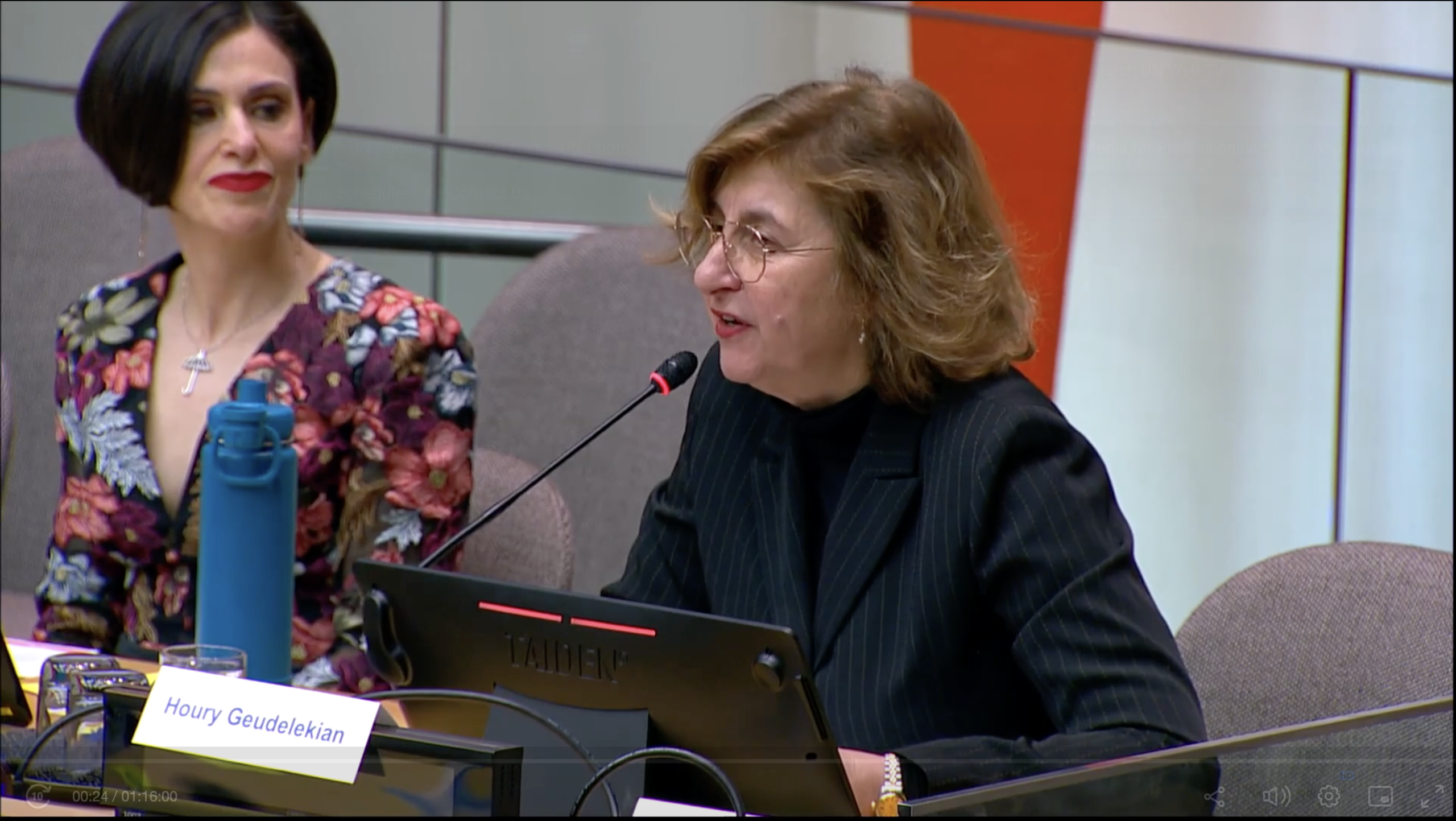
Houry Geudelekian – UN Coordinator and passchair of CSW
The conference was held on March 19, bringing together panelists to discuss the progress in ending child marriage, analyzing both successes and setbacks. Fraidy Ress, a forced marriage survivor, activist, and founder of CS0 Unchained at Last, moderated the discussion.
The first speaker was Dr. Isata Mahol, Minister of Gender and Children’s affairs in Sierra Leone. She highlighted the reduction of child marriage in her country, where rates dropped from 48% in 2008 to 30% in 2019. Dr. Mahol stressed the urgency of continuing this progress through public education, nationwide implementation of the Prohibition of Child Marriage Act, data collection on child marriage and the execution of a national strategy to reduce adolescent pregnancy and child marriage.
Mona Sinha, Global Executive Director of Equality Now explained how child marriage is driven by factors such as climate change, poverty, inequality, conflict and economic insecurity. Each year, 21 million girls are married before the age of 18. She underscored the need for progress to be 20 times faster to achieve the goal of ending child marriage by 2030. To reach this target, she advocated for investment in girls’ education, economic empowerment and access to sexual and reproductive health services, emphasizing the importance of increasing funding for grassroots and survivor-led NGOs.
Sarah Hendriks, UN Women Deputy Executive Director for Policy, Programme, Civil Society, and Intergovernmental Support highlighted the increasingly hostile environment facing gender equality efforts. She pointed out the rise of organized opposition reinforcing traditional notions of girlhood and stressed the need to push back against these forces. She outlined three key strategies to end child marriage.
First, by aligning domestic laws with international human right standards, ensuring the minimum age for marriage is set at 18 without exception.
Secondly, recognizing that criminalization of child marriage is insufficient, and implement approaches involving civil society, education, men, boys and traditional and religious leaders.
Thirdly, by strengthening grassroots women’s movements by providing support and funding.
Last but not least, she called for economic empowerment initiatives, starting with girls’ education and increasing their inclusion in public life.
The Council of Traditional Leaders (COTLA) was also discussed. It is a pan-African network dedicated to eliminating violence against women and girls across the entire continent. Traditional and cultural leaders from various countries have joined forces to promote gender equality and end child marriage.
Saba Lishan highlighted progress made in Africa, noting that education is now free and compulsory in about 47 countries. She explained that accessible education helps keep girls in school longer, delaying marriage. Furthermore, 49 out of 55 African countries have set the legal marriage age at 18 for both boys and girls. However, she pointed out that ongoing conflicts in the region – 17 active conflicts at present – divert resources toward security, making it harder to prioritize gender equality efforts.
The discussion also turned to the United States, where child marriage remains legal in many states, with only 13 states having banned the practice. The paradox is striking: minors have limited legal rights until the age of 18, meaning they often cannot leave home if their husband is abusive, access domestic violence shelters, or file for divorce. Between 2000 and 2021, an estimated 307,365 minors were legally married in the U.S. with the majority being girls. In 79% of these cases, the girls married adult men with an average age gap of four years. Fraidy Ress shared that she is working on a proposal for the Clinton Global Initiative to push for a nationwide ban on child marriage by 2030.
Finally, Mayra Jimenez from the Dominican Republic addressed child marriage as a violation of girls’ and adolescents’ human rights and a direct obstacle to achieving gender equality. President Luis Abinader prioritized this issue, leading to the passage of Law 1-21, which eliminated exemptions that previously allowed child marriage. This reform marked a crucial step in protecting girls’ rights. Before the law, 37% of young women entered marriage or civil unions before turning 18. Since November 2020, the Ministry of Women has launched campaigns to raise awareness, educate communities, and prevent gender-based violence by promoting services for victims and those at risk.
As a conclusion, the conference emphasized how ending child marriage requires multiple strategies: legal reforms, education, economic empowerment, community engagement, and sustained funding for grassroots movements. The path ahead demands collective action and commitment to securing a future where girls everywhere can live free from the threat of child marriage.