Protest Against Taliban Increases After Ban On Women’s Education
Over the last 18 months, the Taliban have gradually implemented comprehensive restrictions on women’s rights. Since the Taliban took over Afghanistan in August 2021, they have enacted systemic policies to prohibit women from attending school.
On September 12th 2021, classes at universities became gender-segregated, and could only be taught by professors of the same sex or older men. Then, on March 23rd 2022, the Taliban confirmed that girls were banned from attending secondary school.
Previously, the Taliban had asserted that schools would reopen for girls, instead they shut the door on tens of thousands of teenage girls and ordered them to stay home. Finally, on December 20th 2022, the Taliban ordered all universities to not accept women until further notice.
Neda Mohammad Nadeem, Minister for Higher Education stated: “You all are informed to implement the mentioned order of suspending education of females until further notice”.
These corrosive human rights policies have now made Afghanistan the only country in the world where education for women is illegal.
Progress in women’s education reversed
Prior to the Taliban’s takeover, education for women was becoming increasingly accessible and developed. This progress has now been completely erased by the Taliban regime.
Enrollment in all levels of education increased tenfold from 2001 to 2021, rising from around 1 million students in 2001 to ca. 10 million in 2018. During this period, the number of women attending higher education in Afghanistan rose from 5,000 female students in 2001 to over 100,000 by 2021. The number of girls in primary school jumped from almost zero in 2001 to 2.5 million in 2018.
Afghan people push back
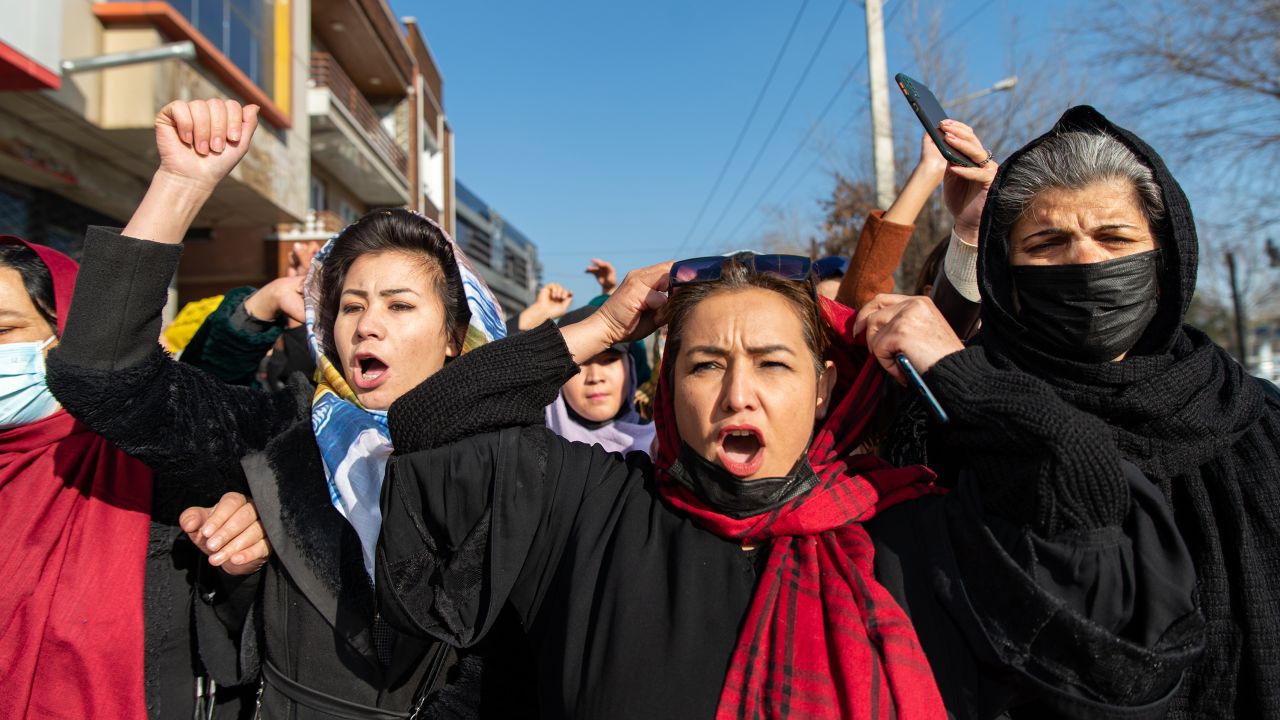
Protesters have been demonstrating throughout Afghanistan against the erosion of human and women’s rights. In Herat, groups of women took to the streets to protest the ban on women attending universities. Taliban officials used a water cannon to disperse the protests, with women reportedly chanting “cowards”. Protests were documented in Kabul, Kandahar and Ghazni, with students and lecturers organizing walkouts, chanting “all or none”. At least sixty Afghan academics have resigned in protest against the Taliban’s decree banning women from higher education.
Professor Ismail Mashal formerly ran a private university in Kabul, with a total of 450 female students. However, after the announcement in December, he closed the university completely, stating “education is either offered to all, or no one”. He subsequently began a comprehensive advocacy campaign against these restrictions.
He went on live television and tore up his degrees, declaring “what use are these degrees to me? This country is no longer a place for education”. Professor Mashal went on to build a wooden cart and took it around Kabul handing out free books to the public. “I decided to give all of these 21,000 books as a gift to students and other compatriots,” Professor Mashal said.
Because of these peaceful displays of solidarity, he was arrested on February 2nd while distributing books in Kabul. Professor Mashal’s aide Farid Ahmad witnessed how the academic was “mercilessly beaten” and taken away in a very disrespectful manner by the Taliban regime.
Education is a human right
Education is a basic human right and is indispensable in realizing other human rights. This failure to provide the basic human right of education will continue to move the Afghan people further into abject poverty.
Afghanistan is in the midst of a humanitarian crisis as almost half the population faces acute hunger. These corrosive restrictions on women’s right to education will threaten the supply of badly needed international aid.
ACHRS strongly condemns the erosion of human rights in Afghanistan at the hands of the Taliban regime and calls for the complete reinstatement of education for women.
ACHRS supports all human rights and women’s rights activists and calls for the immediate release of all Afghan activists arrested by the Taliban for protesting these new restrictions.