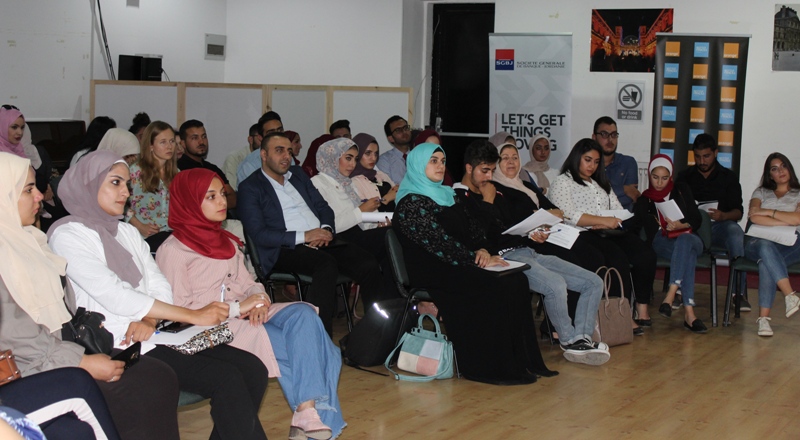
The Amman Center for Human Rights Studies (ACHRS) and the Jordanian Coalition Against the Death Penalty (JCADP) organized a seminar on “The Right to Life and the Death Penalty in Jordan” on Monday, October 14, at the French Institute.
The symposium was moderated by Lawyer Esraa Mahadin, member of the Executive Committee of the Jordanian Coalition Against the Death Penalty, in which MP 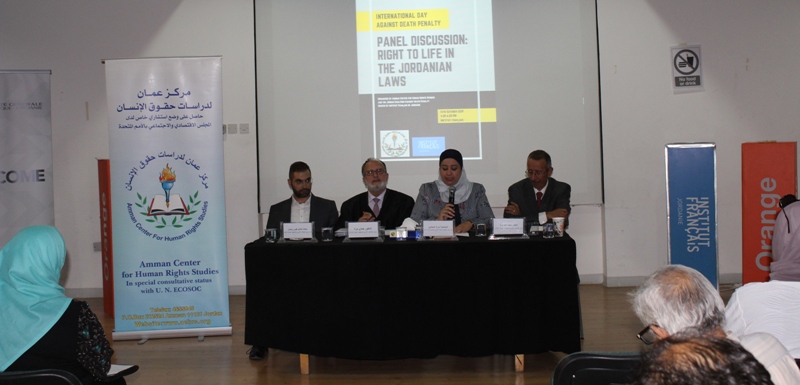 Qais Zayadeen, Dr. Nizam Assaf, Dr. Mohammad Tarawneh and Dr. Hamdi Murad spoke. Dr. Assaf, the director of ACHRS, opened the event by thanking speakers and audience members for their participation, as well as stressing that the right to life is one of the center’s five main objectives. The ACHRS has worked in cooperation with the UNDEF on implementing a project that supports political dialogue between civil society and parliament regarding the death penalty. Throughout this workshop series, participants discussed three key tools to promote the right to life in Jordanian society: raising awareness among local communities, engaging youth, and lobbying decision-makers to adopt a gradual policy of abolishing articles pertaining to the death penalty.
Dr. Mohammed Tarawneh, Chairman of the Arab Coalition against the Death Penalty, began the panel by discussing the global importance of the International Day Against the Death Penalty. He emphasized the significance of garnering global support for the abolition of the death penalty, extending this human right issues beyond a local context. Dr. Tarawneh noted that since World War II, there has been a continuing trend towards abolition of the death penalty. Between 1977 and 2009, the number of countries supporting the abolition increased from 16 to 105. However, in 2018, 800 people were executed in 23 countries including Iran, Saudi Arabia, Pakistan, Iraq and the United States. Many countries are executing people in unfair trials, issuing sentences to those under the age of 18, and using the death penalty against people with mental disabilities. Dr. Tarawneh accentuated this fact as a flagrant violation of international law and standards. In conclusion, he commended the great work done by Jordanian civil society activists to reduce the number of articles that call for the death penalty in Jordan from 32 to 18, limiting sentencing to the most serious crimes.
Dr. Hamdi Murad, a university professor and president of the Jordanian Coalition against the Death Penalty, described the ways in which Islam restricts the use of the death penalty. Islamic law states that the crimes yielding a death sentence are murder, adultery, and intimidation.
He pointed out that the over abundance of articles governing the death penalty in Islamic
countries is due to the fact that the regimes in these countries attempt to obstruct political opponents in an undemocratic manner. Dr. Murad concluded that the Jordanian government must work to eliminate all economic, social, political, and cultural structures that may lead someone to commit a crime.
MP Qais Zayadeen, a member of the Jordanian House of Representatives and Vice President of the Jordanian Coalition against the Death Penalty, reviewed a discussion paper on different tools to influence public and legislative stances on the death penalty. He discussed two trials in the House of Representatives; the first,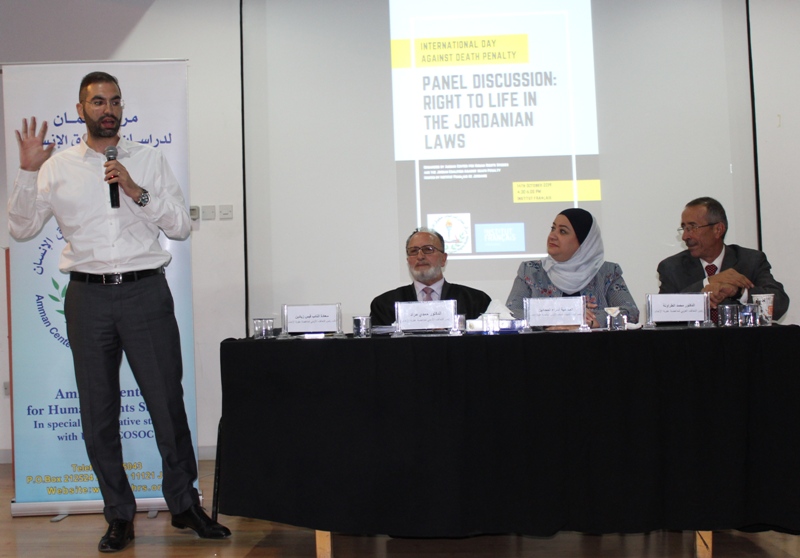 which was successful, was a repeal of article 308 of the Penal Code through extensive campaigning and community outreach. The second was to amend the age of marriage from 16 to 18, which was not successfully amended. MP Zayadeen wrapped up by calling on citizens to use their right to vote in order to activate change. He stated that usually the presence of a bad MP in the House or Representatives is the result of a smart voter who did not exercise their right to vote.
The conference concluded with an open dialogue with the audience in which speakers pointed to the importance of participation in all aspects of Jordanian political and social life. Extensive debate and dialogue regarding the issue of the death penalty is necessary to implement its abolition; solutions and alternatives must emerge from civil society and local communities. Finally, the right to life is a gift from God Almighty and no one has the right to take it away. The conference demanded that the legislative authorities abolish this cruel punishment from the penal code in Jordan.