Human Rights Council: Situation of Human Rights in the Sudan
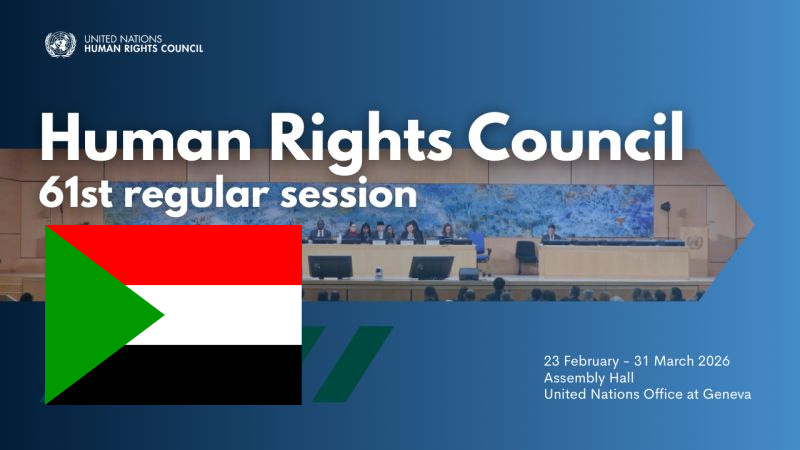
The Human Rights Council convened in Geneva for its 61st session between 23 February and 31 March 2026. Agenda item 2 dealt with the report, Situation of human rights in the Sudan, pursuant to Human Rights Council resolution 57/2. The report was compiled by the United Nations Office of the High Commissioner for Human Rights (OHCHR) in Sudan, and covers the period between 16 November 2024 and 15 November 2025. The report includes information obtained through interviews with 778 sources (380 men, 382 women, 10 boys, and six girls), including victims, their families, and witnesses.
The interviews include those conducted during OHCHR monitoring missions to Chad, Uganda, and the Abyei Administrative Area. Additionally, the report includes analysis of photographs, satellite images and video footage of other United Nations reports, authorities’ statements, and information from other sources. OHCHR, in this report, adopted a ‘reasonable grounds to believe’ standard in assessing the incidents investigated, taking into account their nature and objectivity.
In the report, OHCHR discussed the political and security developments in Sudan, the applicable laws to the conflict, the impact of hostilities on civilians, the impact of hostilities on protected objects, and the use of child soldiers. Other issues covered by the report are the various human rights violations, the humanitarian situation, the impact that the conflict has had on the civic space, and the administration of justice and accountability in the country.
Political and Security Developments
The conflict in Sudan has continued for almost three years, and the mobilization of civilians along tribal and ethnic lines, along with the flow of weapons into the country, has escalated hostilities. During the reporting period, intense fighting continued and expanded to new areas, leading to the deaths of 5,359 non-combatants.
Hostilities in this conflict have been prolonged and the crisis has been deepened, in part, due to the use of unmanned aerial vehicles (drones). Additional factors prolonging the hostilities are external military and arms support for both parties, and the extraction, exportation, taxation, and looting of resources. Gold, livestock, and agri-food commodities such as gum arabic have funded and sustained the conflict.
Legal Framework
Since the previous report in 2024, the Ministry of Justice amended the Constitution to include a 39-month extension of the transitional period, an increase of military representation in the Transitional Sovereignty Council, removing all references to the Rapid Support Forces, and dissolving the investigative committee on the violation by security forces related to the Khartoum protest on 3 June 2019.
As of 15 November 2025, at least 219 emergency orders and security measures were in force in Sudan since the onset of the conflict. This includes curfews, restriction on movement, and restrictions on the freedoms of expression and peaceful assembly.
Impact of Hostilities on Civilians and Protected Persons and Protected Objects
Both parties of the conflict used weapons with wide-area effects in populated areas, often striking densely populated areas without prior warning. This behaviour is contrary to the principles of distinction, proportionality, and precaution under international humanitarian law. The reporting period saw the killings of over 3,700 people.
The reporting period also saw hostilities against other protected persons such as humanitarian and health workers. OHCHR documented the killings of at least 48 humanitarian and health workers during the reporting period.
The parties to the conflict also attacked civilian objects during the reporting period. Targets included markets, schools, and buildings sheltering displaced people. Healthcare facilities were targeted routinely, and the World Health Organization documented 71 attacks on healthcare facilities. Attacks against humanitarian operations were also frequent during the reporting period, with OHCHR documenting at least 19 attacks on humanitarian aid convoys.
Recruitment and the Use of Children
During this reporting period, OHCHR received reports of the forced recruitment of civilians, including children, by the Rapid Support Forces. According to the report, in March 2025, over 300 children, mostly under the age of 16, were undergoing military training.
In May 2025, OHCHR also received reports of forced recruitment and mobilization of children by the Sudanese Armed Forces. These reports include testimonies by children saying that they had been forcibly recruited under threats to their families.
Human Rights Violations
Territorial shifts and reprisals of violence often brought about deliberate arbitrary deprivation of life. OHCHR documented the killing of at least 1,659 non-combatants. Unlawful killings increased drastically in March and April, which saw the killings of 150 and 334 people respectively. These killings were primarily after territorial gains by the Sudanese Armed Forces, and they targeted civilians who allegedly collaborated with the Rapid Support Forces.
OHCHR reported 337 incidents of conflict-related sexual violence, affecting at least 452 victims. The Rapid Support Forces and their allied militias accounted for most (231) of these incidents, followed by the Arab militias (73) and the Sudanese Armed Forces (5). Victims appeared to be targeted on the basis of their affiliation with the Joint Forces, and faced questions such as ‘is your father a member of the Sudanese Armed Forces,’ ‘where are the joint forces?,’ or they were accused of spying. Abduction and sexual slavery by the members of the Rapid Support Forces were also reported during the reporting period. Medical personnel and humanitarian volunteers also experienced sexual violence in areas controlled by the Sudanese Armed Forces.
This reporting period saw a sharp increase in arbitrary arrests and detention, with 825 reported cases. The most pronounced trend was the large-scale detention of civilians by the party taking control of the area, as they targeted supporters of the opposing force.
During this period, the Khartoum State Forensic Medicine Authority reported that it had buried 3,800 unidentified bodies recovered from the streets and homes, raising concerns about potential cases of enforced disappearances.
Civic Space
The civic space continued to shrink due to human rights violations. Parties to the conflict suppressed dissent through arbitrary detention. This includes targeting those expressing anti-war opinions which are often triggered by phone inspections, whose content is interpreted as being indicative of collaboration with the opposing side. Threats and harassment, including hate speech, also intensified during this reporting period. According to the Sudanese Journalists Syndicate, 11 journalists were killed and 16 journalists were arbitrarily detained. Telecommunication and internet disruptions further limited the civic space. The rights to freedom of association and assembly were also unduly restricted in Sudan during the reporting period.
Economic and Social Rights
Due to the ongoing conflict, resources were diverted towards military expenditure, leaving insufficient funding for other services such as healthcare, food, and education. The conflict created and maintained a food crisis in the country, with the Integrated Food Security Phase Classification (IPC) estimating that 24.6 million people were at a crisis level or worse.
The economic situation in Sudan was compounded by high inflation and recurring food hikes which undermined food availability and accessibility. The conflict also undermined the access to safe drinking water, with over 17.3 million people unable to access safe drinking water.
Unsurprisingly, the right to health was also adversely impacted by the conflict, as damage to civilian infrastructure led to consistent disease outbreaks. The report documents over 3,400 deaths and 122,000 suspected cases of cholera since July 2024.
The education sector was not immune to the effects of the conflict, with over 13 million children not being in school as of September 2025, many of whom had not attended school since the beginning of the war.
Humanitarian Situation
The conflict in Sudan has created and maintained the world’s largest displacement crisis, with an estimated 7.2 million people being internally displaced, and approximately 4.3 million people fleeing to neighboring countries since the beginning of the conflict.
December 2024 saw a significant number of returns, which the report attributes to the recapture of Sennar, Al-Gazira, and Khartoum by the Sudanese Armed Forces. An estimated 2.6 million people, mostly women and girls, have returned, in part due to dire living conditions and inadequate humanitarian support in areas of displacement.
Displacement disproportionately impacted people with disabilities, in the form of stigma and the lack of support. Additionally, people with disabilities also faced barriers to accessing basic services such as food, shelter, and participating in decision-making on humanitarian response.
Administration of Justice and Accountability
During the reporting period, OHCHR monitoring indicated a pattern of harsh judicial sentencing, including the use of the death penalty, in areas controlled by the Sudanese Armed Forces. Victims were those accused of being collaborators with the Rapid Support Forces, and the trials often lacked transparency, evidence was obtained through coercion, and lawyers of defendants were often intimidated. In the reporting period, OHCHR documented 321 sentences of capital punishment, and 228 sentences of life imprisonment or long prison terms, which were imposed by criminal and anti-terror courts.
Women and children who were accused of supporting the Rapid Support Forces had their rights to a fair trial and due process violated. At least 8 women were sentenced to death, 3 to life imprisonment, and 4 to long-term prison sentences. During the same period, 5 minors were sentenced to imprisonment and social supervision.
Reflection
ACHRS welcomes the report by OHCHR and the platform created by the Human Rights Council to discuss this topic. The monitoring and reporting of human rights violations is one of the ways to ensure that victims are able to obtain justice upon the cessation of hostilities. This conflict has caused the world’s worst humanitarian crisis which has caused untold suffering which is set to continue indefinitely.
ACHRS will continue to monitor and discuss reports presented to the Human Rights Council on Sudan, including the report on domicide and the report on genocide in El-Fasher. Additionally, ACHRS will provide a more comprehensive analysis of the reports at the conclusion of the Human Rights Council.