The report recommends the establishment of an association for teachers
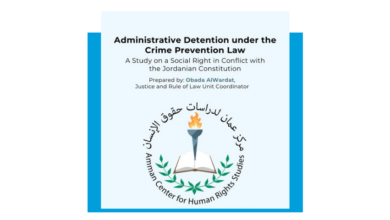
In its annual report for 2010, the Amman Center for Human Rights Studies Recommended the need to establish an association for teachers. The first section of this report focuses on giving a preliminary overview of the unions’ movement in Jordan in the early fifties and the factors that contributed to the establishment of these unions and their role in calling for public freedoms.
In its second section the report touches upon the reality of teachers and the need for a union, the negative impact of economic conditions on the situation of teachers and their right to a decent standard of living, and the impact of all this on the level of teachers’ performance in the educational process and its advancement.
In the third section the report examines the demands of teachers in the establishment of a union for teachers and the historical development of these demands, where the report indicates that the Teachers Association was founded in the fifties and then solved by government decision in 1956, the report shows the repeated demands for the establishment of the union in the years 1978 and 1984 and 1990, leading to their success in winning support from the Parliament to their demand in 1994, but the Senate rejected a bill for the Teachers Association transferred from Parliament on the basis of the Higher Council’s resolution for the interpretation of the Constitution, which recognized the unconstitutionality of the government teachers union. Then resumed their demands for the establishment of the union in 2010 and dialogue is still ongoing between government agencies and committees of teachers demanding the establishment of the union, and the government is still not responding to these demands under the pretext of fear of the politicization of the union, the last demand for the establishment of the union had been presented to the Parliament XVI on 3 / 12 / 2010, which was endorsed by about 39 members.
In its fourth section, the report highlighted the right to form and join unions according to international standards as reflected in the constitution of the International Labour Association (ILO) of 1919, the convention of Freedom of Association and Protection of the Right to Organize No. 87 of 1948, the Universal Declaration of Human Rights of 1948, Convention No. 98 of 1949 on the right to organize and negotiate, the International Covenant on Civil and Political Rights of 1966, the International Covenant on Economic, Social, and Cultural Rights of 1966, and the Arab Charter for Human Rights in 2004.
The report states the right to form and join unions in the constitutional standards and in particular Article (16 / 2) and Article (23), which allowed the right to organize free union within the limits of the law. Where the report shows there is no constitutional text or a text of any other law that prevents the establishment of a teachers union or any private profession, and that this association existed during the period between 1952 and 1956. The report also showed that the decision of the High Council to Interpret the Constitution was issued by a single vote difference, which shows the existence of different legal interpretations.
The report showed that the right to organize is for all types of professions, and the profession of education is one of them, which is a basic right stipulated in the Constitution and ratified international conventions, and then it is not to infringe upon or prejudice to as an international legal obligation that is superior to any domestic decision or legislation, and it is applied within the frame of the law of different professions, which include workers in the public and private sectors, not to mention that this right confirmed in practice and legislation in Western countries, from which Jordanian constitution is taken.
The report included the following conclusions:
Teachers in Jordan live a legally difficult situation that adversely affect their performance of the mission of teaching and education for the younger generations, and this made them researchers for providing the minimum requirements of the life that is heavily loaded with costs and requirements, especially with their lack of legal regulation that saves them with the minimum rights and frames the participatory relationship with the family, school, and student to draw the future.
In the opinion of the Amman Center for Human Rights Studies that political and social forces that reject the existence of a union and resist it are still justified by the fear of the politicization of the Association and converting it into party frames, which may in the future pressure on the successive governments because of the sensitivity and the size of this category of the society, and in turn the government allows all other professions and their members to form unions in a discriminatory policy inconsistent with the democratic right and all other human rights guaranteed by international conventions. There is also the government’s fear of the possibility of control of the union on its member-teachers and perhaps oblige them to sit or strike in appeal to political issues or demands that are beyond the limits of union work as determined by international conventions and ethics of the profession and the legitimate interests of members.
The Amman Center for Human Rights Studies stresses that teachers are in dire need of the union like the teachers in most countries of the world to defend their rights, care for their interests, improve the terms and conditions of work, raise the cultural and social level of skills, and the opportunity to participate in the development and implementation of education curricula and training plans and programs and other things. The re-production governmental organization forms into new ones under the names of clubs and associations to offload union content means that the problem of union representation and embodiment of their aspirations and the transfer of their demands still exist and will be doomed to failure.
The Amman Center for Human Rights Studies confirms that the joining of teachers in this union organization is the right under the provisions of the Constitution and international treaties and conventions and practice in democratic societies, and the establishment of the union must take into account international standards, including: joining the union be voluntary and non-mandatory, and the availability of various union representation for teachers.
Finally, the Amman Center urges institutions of civil society to demand that the government respect the Constitution, which guarantees the right to union organization, especially since the teachers union was established in the fifties of the last century and has been dissolved for political reasons that have been overcome by developments in the Kingdom, and that the decision of the High Council to interpret the Constitution accepts the diversity of legal readings upon which a number of observations were recorded by the legal experts to be compatible with the Constitution and international conventions acceded to by Jordan.
The Amman Center for Human Rights Studies recommends the following:
- Ensure the right to organize and freedom of association for all types of professions, and the profession of education, as a right guaranteed by the Jordanian Constitution and ratified international conventions.
- Depict experiences of democratic societies which provide teachers the right to organize unions, whether in public or private sectors, to take care of their interests and develop their careers.
- Re-read Article 120 of the Constitution on the grounds that union work is not about the authority of the government in administrating its employees.
- Adopt the principle of notification in the establishment and joining of unions instead of getting a license.
- The government refrains from intervening in the affairs of unions and limiting union rights.
- Include items of law of Teachers Association / Federation of Teachers to allay the fears of governments to politicize the union and maintain the professionalism of the union.
- Capacity development of teachers and raise their standard of living and re-appreciation of the teaching profession.
- Civil society advocacy of the issues of teachers and their demand in the establishment of the union.
- Urged other professional unions to embrace the demands of teachers in establishing a union just like theirs for their support and work in direct dialogue with the government.
It is to be mentioned that the Amman Center for Human Rights Studies has been issuing specialized annual reports since 2005. It dedicated the annual reports of the years 2005, 2006, 2007, and 2008 to press freedoms in the Arab world, the annual report of 2009 to the right to access information in Arab countries, and the sixth annual report of 2010 has been allocated to the subject of the right to form a union for teachers in Jordan.
The Centre will continue to issue annual reports specialized in Jordanian or Arab human rights issues as a contribution to the promotion, protection, and consolidation of the culture of human rights in Jordan and the Arab world.
To see the full report in Arabic, you can log on to the site of the Amman Center for Human Rights Studies at the following link:
http://achrs.org/images/stories/news/center/pdf/teachers-association.pdf.